

Short answer. Using AI in hiring is legal in Canada, and Alberta has no AI-specific hiring rule. The Alberta Human Rights Act still applies to every job ad and screening step, with no need to prove intent, and PIPA governs applicant data. Ontario requires employers with 25 or more employees to disclose AI screening in public job postings from 1 January 2026. Quebec requires notice when a decision about a person is made exclusively by automated processing. Keep a person on every rejection.
Law verified 23 September 2026. Not legal advice.
Illustrative example, not a client case study. A Calgary head office posts a warehouse supervisor job for its new Mississauga site. The posting goes up on a job board the same way the last few did. The applicant tracking system, meaning the software that collects applications and sorts them, scores and ranks every resume with a built-in AI feature somebody switched on during a free trial. Under Ontario’s rules, that counts as AI in hiring.
Nobody in Calgary thinks of it that way. Ontario does.
Since 1 January 2026, an employer with 25 or more employees must say in a publicly advertised posting if it uses artificial intelligence to screen, assess or select applicants. The rule follows the job, not the head office. And the AI in that scenario isn’t some separate product the company bought. It is a feature inside software the company already pays for.
That is the pattern with AI in hiring across Canada. The rules are few and scattered, and the exposure mostly comes from tools people don’t realize are making choices. What follows is the map for an Alberta employer, and the checklist I’d run before letting any tool near a resume pile.
AI in hiring in Canada: which rules reach an Alberta employer
Four sets of rules matter for AI in hiring in Canada. The Alberta Human Rights Act and Alberta’s Personal Information Protection Act always apply to Alberta hiring. Ontario’s job posting disclosure rule applies to Ontario roles. Quebec’s automated decision notice applies to fully automated decisions about people in Quebec.
| Rule | What it requires | When it reaches an Alberta employer |
|---|---|---|
| Alberta Human Rights Act | No discrimination on protected grounds in job ads, applications, hiring and employment. Intent doesn’t matter. | Always, for Alberta hiring, whatever tool you use |
| Personal Information Protection Act (Alberta) | Collection of applicant information must be reasonable and tied to the employment decision. Policies must cover service providers outside Canada. | Always, for applicant and employee data you hold |
| Ontario Employment Standards Act, job postings | Disclose any use of AI to screen, assess or select applicants in the posting. Also pay ranges, vacancy status, no Canadian experience requirement, and a reply to interviewed applicants within 45 days. | When you post a public job for Ontario and have 25 or more employees |
| Quebec private sector privacy law, section 12.1 | Tell a person when a decision about them is based exclusively on automated processing, explain the factors on request, and let them submit observations to someone who can review it. | When you make a fully automated decision about someone in Quebec |
There is no federal AI law sitting above these. The national AI strategy released in June 2026 doesn’t introduce comprehensive AI legislation, and Miller Thomson’s analysis of the strategy reads it as leaving the old Artificial Intelligence and Data Act unlikely to return. The full picture is in AI regulation in Canada and Alberta for business.
Is it legal to use AI to screen resumes in Alberta?
Yes. No Alberta law bans or specifically regulates AI resume screening. The Alberta Human Rights Act applies to the outcome, though, so if a tool screens out applicants in a pattern linked to age, gender, race, disability or another protected ground, the employer is responsible, even if nobody intended it.
The Alberta Human Rights Commission’s list of protected areas names employment advertisements and applications as their own protected area, separate from employment itself. Screening is squarely inside it. The commission also states that discriminatory intent is not required.
That second point is the one that matters for AI. A model trained on who you hired before learns who you hired before. If your past hires skew one way, a tool that copies them skews the same way, and nobody has to intend anything for the result to be discrimination.
The best-known example is eight years old and still instructive. Reuters reported in October 2018 that Amazon scrapped an experimental recruiting tool after finding it penalized resumes containing the word “women’s” and downgraded graduates of all-women’s colleges. It had learned from ten years of resumes submitted mostly by men.
Age is the ground I’d watch most closely in Alberta hiring. Screening on graduation year, “years of experience” caps or gaps in work history can land on older applicants, and on people returning from caregiving, without anyone typing a protected ground into a filter.
Do you have to tell applicants you use AI in Canada?
In Ontario, yes, for employers with 25 or more employees who post a public job and use AI to screen, assess or select. In Quebec, yes, when a decision is made exclusively by automated processing. Alberta has no disclosure rule, but telling applicants anyway is cheap and removes a surprise.
Ontario’s guide to the job posting requirements sets out the whole package that took effect on 1 January 2026. The 25-employee count is taken on the day the posting goes up, and part-time, casual and probationary staff and people on leave all count. Postings must also carry a pay figure or a range no wider than $50,000, unless the pay is over $200,000. Records of postings and applicant communications must be kept for three years.
The AI part is where employers are struggling. Osler, the national law firm, noted that the regulation doesn’t define “screen,” “assess” or “select,” and that AI now sits inside ordinary office software, which makes it hard to know when disclosure is triggered. The regulation borrows a broad definition of AI: a machine-based system that infers from its input to generate outputs such as predictions, recommendations or decisions. Osler’s analysis is worth reading in full if you hire in Ontario.
Quebec’s rule is narrower and older. Since September 2023, section 12.1 of Quebec’s private sector privacy law has required an organization to inform a person when a decision about them rests exclusively on automated processing of their personal information. On request, the organization has to explain the information used and the principal factors behind the decision, and give the person a chance to submit observations to someone who can review it. A human who genuinely reviews the decision takes you outside “exclusively automated,” which is one more reason to keep a person in the loop.
My position is simple. Disclose AI use in every posting, Ontario or not. One sentence covers it, and it costs nothing next to the trust you lose when an applicant finds out later.
Where AI helps in hiring without the legal risk
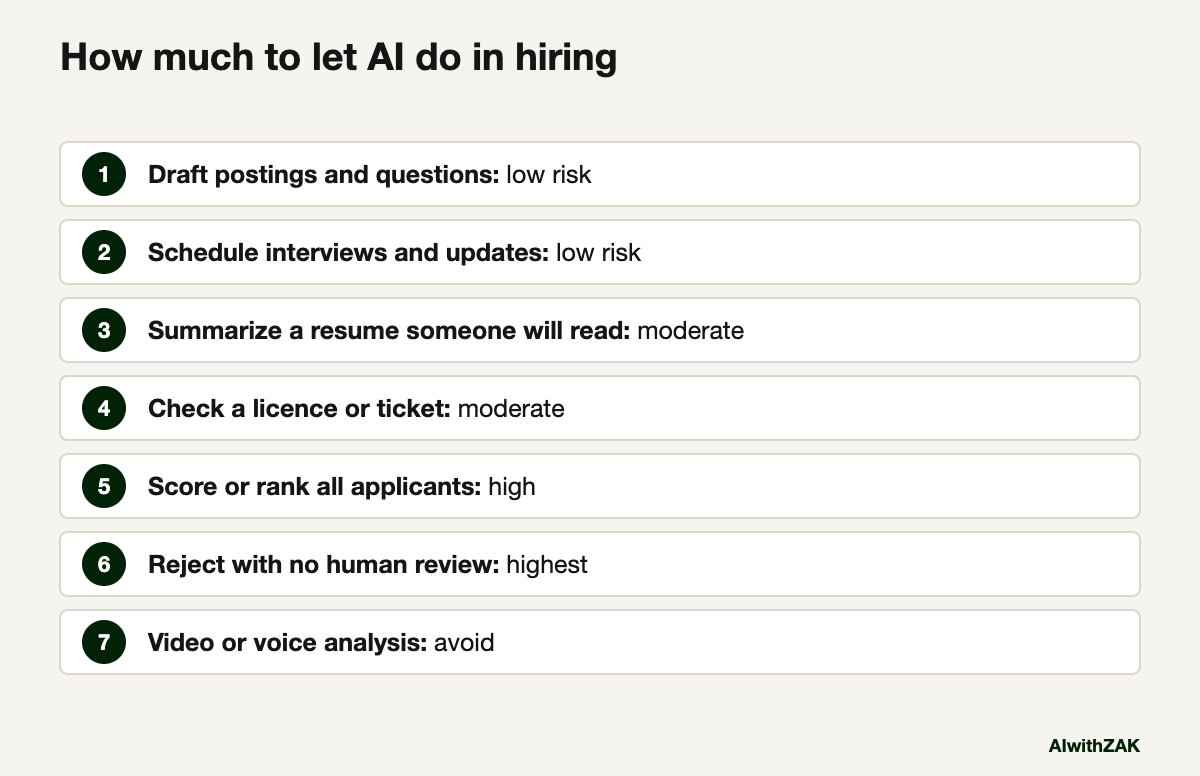
AI is safest in hiring where it drafts, schedules and summarizes for a person who decides. It carries the most risk where it scores, ranks or rejects applicants on its own. Most of the time saved in hiring comes from the safe end of that range.
| Task | Risk level | Why |
|---|---|---|
| Drafting job postings and interview questions | Low | A person reviews the text, and AI can flag exclusionary wording |
| Scheduling interviews and sending updates | Low | Admin only, and it helps meet Ontario’s 45-day reply rule |
| Summarizing a resume a person is about to read | Moderate | Summaries can drop details, so the reader still opens the resume |
| Checking hard requirements such as a licence or ticket | Moderate | Fine if the requirement is genuine for the job and checked by a person |
| Scoring or ranking all applicants | High | Hidden patterns can track protected grounds, and disclosure rules apply in Ontario |
| Automatic rejection with no human review | Highest | Human rights exposure in Alberta, a section 12.1 notice duty for Quebec applicants |
| Video or voice analysis of candidates | Avoid | Hard to explain, easy to tie to disability, accent or appearance |
Don’t let AI reject anyone. Let it sort, summarize and schedule, and keep every no with a person who can say why.
That rule costs less time than it sounds. I’d argue the slow part of hiring for most Alberta companies isn’t reading resumes. It is the back-and-forth of scheduling, chasing references and writing the posting in the first place, and that work is where AI earns its keep.
Illustrative example, not a client case study. An Edmonton trades contractor with 80 staff hires journeyperson electricians every spring. AI drafts the posting from the last one, checks it for wording that might put off older or female applicants, confirms each applicant has listed a valid ticket, and books interviews into the supervisor’s calendar. The supervisor reads every resume that has the ticket. Nothing is scored, and nobody is rejected by software.
What should an Alberta employer check before using an AI hiring tool?
Before any AI tool touches applications, know exactly what it does, what data it uses, where that data goes, who reviews its output, and how you would explain a rejection to an applicant or the Human Rights Commission. If any answer is “we don’t know,” the tool isn’t ready.
This is the checklist I would run, in this order:
- 1. Find the AI you already have. Check your applicant tracking system, job board accounts and HR software for scoring, ranking, matching or auto-reply features, and note which ones are switched on.
- 2. Write down what each tool decides. Draft, sort, score or reject. Anything past “sort” needs a named person reviewing it.
- 3. Check the inputs. Remove graduation years, photos, addresses and anything else that can stand in for a protected ground, unless the job genuinely needs it.
- 4. Test it on your own past applicants. Run a set of real, anonymized past applications through the tool and compare its picks with who you actually interviewed. Look for patterns by age and gender where you can.
- 5. Read the vendor contract. Where is applicant data stored, can the vendor train on it, and what happens to it when you leave? Alberta’s PIPA rules for service providers outside Canada require your policies to name the country if a service provider outside Canada handles it.
- 6. Update the posting template. Add a plain AI disclosure line, and for Ontario roles, the pay range, vacancy statement and no Canadian experience requirement.
- 7. Keep records. Ontario requires three years for postings and applicant communications. Keeping the same for Alberta roles costs you nothing.
- 8. Give applicants a way to ask. A named contact who can explain a decision covers the Quebec rule and is simply good practice everywhere.
Steps 4 and 5 are where most of the value sits. The broader version of step 5 lives in the questions to ask any AI vendor before you sign, and step 1 is a specific case of finding the shadow AI already in your company.
If you can’t explain why a tool rejected someone, you shouldn’t be using it to reject anyone.
How should AI in hiring fit into your AI policy?
Give hiring its own paragraph in the policy. Name the approved tools, the tasks they may do, the tasks reserved for people, the data that must never go into a general chatbot, and who signs off on any new screening feature.
It takes a recruiter or supervisor ten seconds to paste a resume into a free chatbot to “just get a summary.” That is applicant personal information leaving your control. Alberta’s rules on personal employee information allow collection without consent only where it is reasonable and tied to the employment decision, and a free chatbot is hard to square with that. The fix is an approved business tool and a line in the policy. The AI acceptable use policy template has a slot for it, and the AI governance checklist puts hiring among the decision points that need a human sign-off.
Worried staff will ask what all this AI means for their own jobs. That question has better answers in the data than most people expect, and what the Canadian data says about AI and jobs is the piece to send them.
Start with step 1 this week. Log into your applicant tracking system, open the settings, and find out what it has been deciding without you.
Questions people ask
Yes. No Canadian law bans AI resume screening. Human rights laws apply to the results, so an employer is responsible if a tool screens out people in a pattern linked to a protected ground. Ontario requires disclosure in public job postings for employers with 25 or more employees, and Quebec requires notice of fully automated decisions.
No. Alberta has no AI disclosure rule for job postings as of September 2026. The Alberta Human Rights Act still covers job ads and applications, and Alberta’s Personal Information Protection Act governs applicant data. Alberta employers posting jobs located in Ontario must follow Ontario’s disclosure rule for those roles.
Since 1 January 2026, employers with 25 or more employees must include a statement in publicly advertised job postings disclosing any use of artificial intelligence to screen, assess or select applicants. The same rules require a pay figure or range, a statement saying if a vacancy actually exists, no Canadian experience requirement, and a reply to interviewed applicants within 45 days.
Yes. A tool trained on past hiring decisions can copy past patterns. Reuters reported in 2018 that Amazon scrapped an experimental recruiting tool that penalized resumes containing the word women’s. Under the Alberta Human Rights Act, discriminatory intent is not required, so the employer is responsible for the outcome.
It applies when a decision about a person is based exclusively on automated processing of their personal information. The organization must inform the person, explain the information and principal factors used on request, and let them submit observations to someone who can review the decision. Genuine human review of each decision takes it outside that rule.
Possibly. Many applicant tracking systems include resume scoring, candidate matching or ranking features. Check the settings and the vendor’s documentation for any feature that scores, ranks or filters applicants, and treat it as AI screening until you have confirmed otherwise.
Only through an approved business account that doesn’t train on your data, and only as a summary for a person who still reads the resume. Pasting applicant resumes into a free personal chatbot sends personal information outside your control, which your obligations under Alberta’s Personal Information Protection Act make hard to justify.