


Short answer. Will AI replace jobs in Canada? Not in large numbers so far. Statistics Canada found 89.4% of businesses using AI reported no change in employment after adopting it, while most reported AI taking over some tasks. 35.9% of Canadian workers used generative AI on the job in the year to March 2026. The first measurable effect is on hiring: the Bank of Canada found workers in highly exposed occupations having more trouble finding jobs, with no matching rise in layoffs. Plan for changed tasks and slower junior hiring.
Statistics verified 23 September 2026.
AI is taking tasks at Canadian companies much faster than it is replacing jobs. The numbers on that are clear enough now that any owner can plan around them.
When Statistics Canada asked AI-using businesses in 2025 what happened to their headcount after they adopted it, 89.4% said nothing. 6.3% said employment went down and 4.3% said it went up. In the same survey, 84.9% said AI had taken over at least some tasks employees used to do.
Read those two numbers together. Most companies using AI changed the work and kept the people.
That doesn’t mean nothing is happening. A Bank of Canada analysis from August 2026 found the first real labour market signal, and it isn’t where the headlines put it. It shows up in hiring. For an Alberta company, that changes what to plan for.
Will AI replace jobs in Canada? What the data shows so far
So far, AI is changing tasks inside jobs far more than it is eliminating jobs in Canada. Most businesses using AI report no change in headcount, most workers use generative AI for some tasks, and the earliest measurable effect is slower hiring into highly exposed occupations.
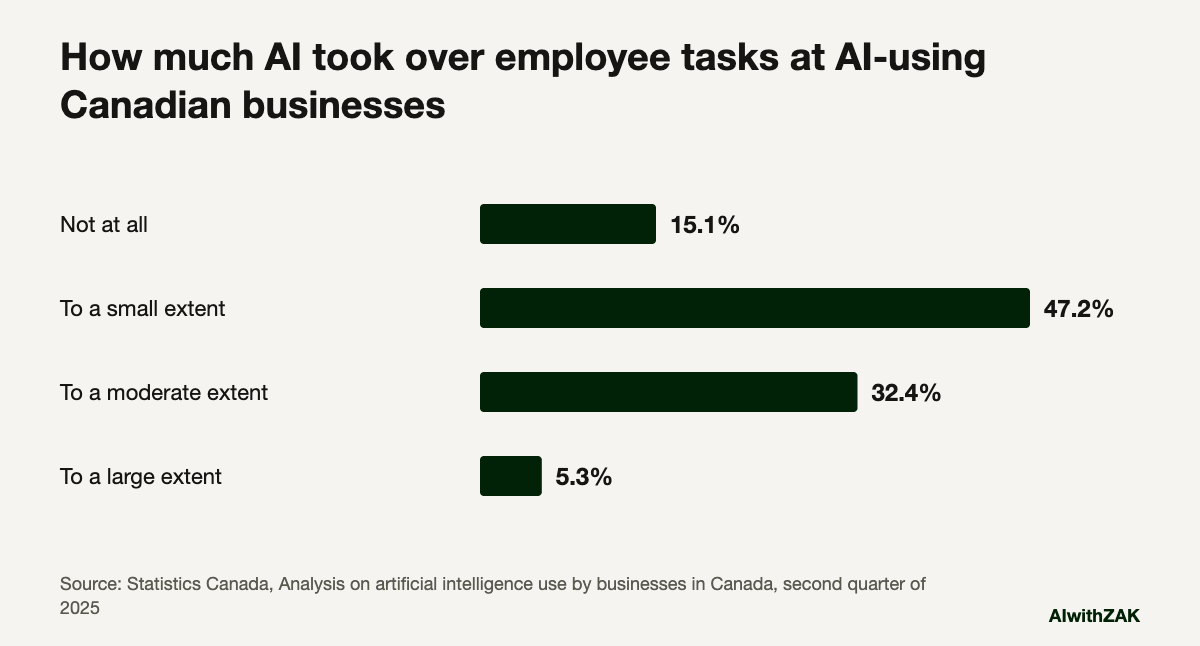
The business side comes from Statistics Canada’s Canadian Survey on Business Conditions. In the second quarter of 2025 analysis, among businesses that had used AI in the previous year, task displacement looked like this:
| Extent to which AI took over tasks employees used to do | Share of AI-using businesses |
|---|---|
| Not at all | 15.1% |
| To a small extent | 47.2% |
| To a moderate extent | 32.4% |
| To a large extent | 5.3% |
Only one AI-using business in twenty said AI took over tasks to a large extent. That is the population the displacement stories are really about, and it is small.
Adoption has grown since. By the second quarter of 2026 business survey, 19.2% of Canadian businesses reported using AI to produce goods or deliver services, up from 12.2% a year earlier and 6.1% two years earlier. Statistics Canada’s 2026 analysis of AI use by businesses didn’t repeat the headcount question. It asked about staffing and training changes instead: 44.4% of AI-using businesses made one, and the most common was AI training for existing employees, at 32.0%. Among businesses with 100 or more employees, 32.8% hired people with AI skills.
Training the people you have is what companies are actually doing. Replacing them is not, at least not yet and not in numbers the survey can see.
On the worker side, Statistics Canada’s release on generative AI use among workers reported on 30 July 2026 that 35.9% of workers had used generative AI tools in their main job in the 12 months to March 2026, and 41.6% had used at least one AI or automation technology. Among those using generative AI, 63.5% described their use as moderate, applied to some tasks, and 24.9% described it as minimal. Most people use it for part of their work.
Which jobs in Canada are most exposed to AI?
Statistics Canada estimates about 31% of Canadian employees work in jobs highly exposed to AI with low complementarity, meaning AI could take on much of the work. Another 29% are highly exposed but highly complementary, meaning AI more likely helps them, and 40% have low exposure.
Two terms need a plain gloss. Exposure means how much of a job’s task list overlaps with what AI can do. Complementarity means how much the job also depends on things AI does poorly: physical work, responsibility for others, judgment in unpredictable settings, face-to-face contact. A job can be highly exposed and still safe if the exposed tasks are the tedious ones.
The estimates come from Statistics Canada’s Experimental Estimates of Potential Artificial Intelligence Occupational Exposure in Canada, published in September 2024 using May 2021 employment. The July 2026 worker survey, as reported by Global News, lines up the same categories against actual generative AI use:
| Category | Share of employees (2021) | Typical jobs | Used generative AI at work (to March 2026) |
|---|---|---|---|
| High exposure, high complementarity | 29% | Doctors, nurses, teachers, engineers | 53.8% |
| High exposure, low complementarity | 31% | Office support, retail, software development | 45.9% |
| Low exposure | 40% | Trades, service work, first responders | 14.2% |
Two findings from that research matter for Alberta. First, AI exposure runs opposite to earlier automation waves. It reaches highly educated, office-based work more than manual work, and the same research found those workers also most likely to hold complementary jobs. Second, the trades are the least exposed. A January 2026 Statistics Canada study of certified journeypersons found most plumbers, carpenters and welders less exposed to AI-related job change than other workers, though about 20% of journeyperson workers were at high risk from conventional automation, against 13% in other occupations.
For a province built on energy services, construction and the trades, that is useful. The work AI touches first in an Alberta company is the office behind the field crew: estimating, scheduling, invoicing, reporting, proposals.
Where is AI actually affecting Canadian employment?
In hiring. A Bank of Canada analysis published in August 2026 found the extra unemployment risk for workers in highly exposed jobs grew from 1.9 percentage points in 2015 to 2019 to 2.8 points in 2025, driven mainly by difficulty finding work rather than more layoffs or resignations.
The Bank of Canada analysis, by Dany Brouillette, Tatjana Dahlhaus and Gabriela Galassi, compared workers in jobs with full AI exposure against those with none. The gap in unemployment risk widened by almost a full percentage point. The authors trace it to falling job finding rates among highly exposed workers, and they note that many entry-level roles in customer service and sales support carry moderate to high exposure, which puts young workers closer to the effect. They also say plainly that evidence of a significant overall labour market impact remains limited.
This is the pattern I expect Alberta companies to follow. Nobody gets called into an office and told AI replaced their job. Instead, when someone in accounts payable retires or a junior coordinator moves on, the role doesn’t get posted again, because the remaining team plus a few tools now covers it.
That is a slower, less visible kind of change, and it has a cost most owners haven’t priced.
Junior roles are where people learn the business. Stop hiring them and in five years you have no one ready to replace your senior estimator, your controller or your lead dispatcher. The retiring expert problem gets worse, not better, if AI is the reason the apprentice seat stays empty.
Who is right about AI replacing jobs, the optimists or the pessimists?
Nobody knows yet, and the Canadian data supports neither extreme. Current numbers show task change and slower hiring in exposed jobs, not mass layoffs. A sensible plan works in both cases: train existing staff, redesign roles around the tasks AI takes, and keep hiring juniors on purpose.
One camp expects AI to cut large numbers of office jobs within a few years as the tools get better at whole workflows. The other expects it to behave like past technology, raising output per person and shifting work around without shrinking total employment.
If the first camp is right, the companies that come through best will be the ones whose people already know how to direct AI, because they will be the ones redeployed rather than cut. If the second camp is right, those same people will be the most productive staff you have. Either way, the move is identical: train the people you have now, and do it before you buy another tool.
Both camps also agree on one thing the survey data backs up. Whatever happens to jobs, the tasks inside them are changing now. Statistics Canada’s 2025 numbers put that at 84.9% of AI-using businesses.
What should an Alberta employer tell its team about AI and jobs?
Tell them what the data shows and what your company intends: which tasks go to AI, what training they get, and how roles will change. Without a stated position, staff assume the worst. A clear written position on jobs does more for adoption than any tool rollout.
Staff who expect AI to replace their jobs tend to hold back from it, or use it where you can’t see it. Both outcomes cost you. The approach to leading AI change without resistance starts with saying out loud what you will and won’t do.
A useful position has three parts, written down and shared:
- The tasks. Name the work you plan to hand to AI first, such as invoice entry, report drafting or quote preparation.
- The people. Say what happens to the time freed up, and be honest if some roles will not be refilled when people leave.
- The training. Commit to specific training, for everyone, starting with supervisors, since the people who run teams need it first.
Be careful about promises. “Nobody will lose their job because of AI” is a sentence few owners can guarantee for five years. “We will train everyone and redesign roles before we cut any” is one you can keep.
If hiring itself is where AI is entering your company, the rules on that are in using AI to screen resumes in Alberta. If nobody yet owns these decisions, settle who should own AI in your company before the first role goes unfilled. And for the workforce side in full, building an AI-ready workforce is the longer version of this section.
My position, for what an Alberta owner should do this year: keep hiring at least one junior into every function where AI is taking tasks. The tools will cover the work. They won’t grow your next senior person.
Questions people ask
Not in large numbers so far. In Statistics Canada’s 2025 business survey, 89.4% of businesses using AI reported no change in employment after adopting it, 6.3% reported a decrease and 4.3% an increase. The Bank of Canada found the first measurable effect in 2026 research: slower hiring into highly exposed occupations rather than more layoffs.
Statistics Canada reported on 30 July 2026 that 35.9% of workers had used generative AI tools in their main job in the 12 months to March 2026. 41.6% had used at least one AI or automation technology. Use ranged from 65.6% in professional, scientific and technical services to 16.3% in accommodation and food services.
Statistics Canada estimates 31% of employees work in jobs highly exposed to AI with low complementarity, such as office support and some retail roles, where AI could take on much of the work. Trades, service work and first responders have the lowest exposure. Highly educated office work is more exposed than manual work.
Mostly, from AI. A January 2026 Statistics Canada study found most certified journeypersons, including plumbers, carpenters and welders, less exposed to AI-related job change than other workers. About 20% of journeyperson workers were at high risk from conventional automation, against 13% in other occupations, so conventional automation matters more than AI for the trades.
Mostly training them. In Statistics Canada’s second quarter 2026 survey, 44.4% of AI-using businesses changed training or staffing practices, and the most common change was AI training for existing employees, at 32.0%. Among businesses with 100 or more employees, 32.8% hired people with AI-related skills.
There are early signs. A Bank of Canada analysis published in August 2026 found unemployed workers in highly exposed occupations having more trouble finding jobs, and noted that many entry-level customer service and sales support roles carry moderate to high AI exposure. The authors say the overall labour market impact remains limited.