


Short answer. To show up in AI search, make your business easy for answer engines to find, read and trust. Let their search crawlers into your site, keep your name, address and services identical everywhere they appear, complete your Google Business Profile, open key pages with a direct answer, earn mentions in local media and directories, set up Bing Webmaster Tools and Google Search Console, and test the answers yourself once a month. Google says AI Overviews need no special markup or AI text files.
Crawler documentation and Google guidance verified 23 September 2026.
On 1 July 2025, Cloudflare started blocking AI crawlers by default on every new domain it protects. If your web developer put your site behind Cloudflare for speed and security after that date, and nobody changed the setting, the crawler ChatGPT uses to find sources for its search answers may have been turned away at the door ever since. You can’t show up in AI search if the crawler never gets past the front door.
That one setting explains a lot of “why does ChatGPT recommend my competitor and not us” conversations. It is also the cheapest thing on this list to fix.
The rest is less exotic than the label GEO suggests. GEO is the industry’s term for getting cited by AI tools. Google’s own guidance for its AI features says the ordinary SEO basics still apply and that you don’t need new machine-readable files or special markup. My view is that the fundamentals that have always driven search do most of the work in AI answers too, which is good news for a business with a small budget. The steps below are what changes who gets named for a Calgary plumber, an Edmonton law firm or a Grande Prairie equipment dealer.
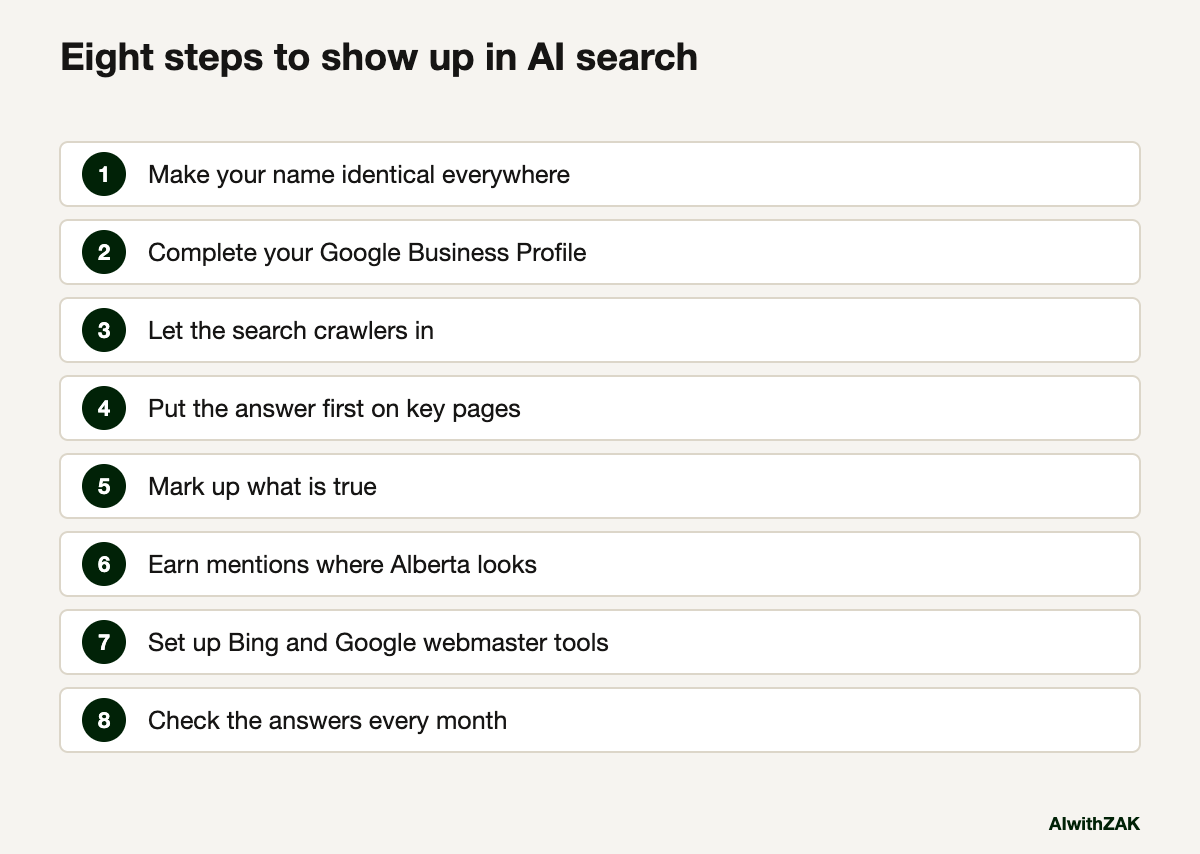
Eight steps, in the order I would do them.
How to show up in AI search, step by step
Answer engines name businesses they can crawl, understand and corroborate. Fix access first, because nothing else matters if the crawler is blocked. Then make your identity consistent, answer questions plainly on your own pages, and get credible Alberta sites to mention you, since models trust what several sources agree on.
1. Make your name identical everywhere. An AI system builds a picture of your business as an entity, meaning the single thing it understands “you” to be, by stitching together your website, your Google listing, directories, news stories and reviews. If your site says “Bow River Mechanical Ltd.”, your Google profile says “Bow River Plumbing & Heating” and an old directory still has the phone number from before you moved off 17th Avenue, the model sees three weak signals instead of one strong one. Pick one name, one address format, one phone number and one short description, then use them everywhere.
2. Complete your Google Business Profile. Google’s AI features guidance tells site owners to keep Business Profile details current, and its help page on improving your local ranking names three factors: relevance, distance and prominence. Prominence is how well known you are, which Google says draws on things like links to your business and your reviews. Fill in every category, service and hour. Reply to reviews. Add real photos of your shop and crew.
3. Let the right crawlers in. Check your robots.txt file, a plain text file at yourdomain.ca/robots.txt that tells bots where they may go, and check your Cloudflare or hosting firewall settings. The next section lists which bots to allow and what each one actually does.
4. Put the answer first on the pages that matter. Answer engines lift passages. A service page that opens with two paragraphs about your founding story gives the model nothing to quote. Open each important page with one or two sentences that answer what a customer would type: what you do, where, for whom, and roughly what it costs or how long it takes. Detail goes underneath.
5. Mark up what is true. Structured data, meaning code that labels facts on the page for machines, helps search engines confirm your name, address, hours and services. Use Organization or LocalBusiness markup that matches the visible text exactly. Google’s guidance is specific on this point: structured data must match what people can see on the page.
6. Earn mentions where Alberta looks. Your own site is one source. Answer engines prefer businesses that other credible sources also describe. That means your chamber of commerce directory, your industry association’s member list, local business press and supplier “find a dealer” pages. In my view, one feature in a Calgary or Edmonton business publication that describes what you do in plain words is worth more than another blog post on your own site. It is also the step most owners skip.
7. Set up Bing Webmaster Tools and Google Search Console. Both are free. Microsoft added an AI Performance report to Bing Webmaster Tools in February 2026 that shows how often your pages are cited as sources in Copilot and Bing’s AI-generated summaries, and which pages get cited. Google reports AI Overviews and AI Mode traffic inside the ordinary Performance report in Search Console, under the Web search type. Neither tells you everything. Both tell you more than guessing.
8. Check the answers yourself every month. Ask ChatGPT, Perplexity, Gemini and Google the questions your customers ask, write down who gets named, and compare month to month. The last section has a routine and a prompt you can paste.
Illustrative example, not a client case study. Picture a Red Deer heating and cooling company whose site blocks AI crawlers through a Cloudflare default, whose Google profile lists last year’s hours, and whose only outside mention is a directory with an old phone number. Ask Perplexity for furnace repair in Red Deer and the answer will lean on whichever competitors it can actually read. Nothing about the company’s work is worse. It is simply invisible to the tool doing the recommending.
The diagram below puts all eight steps on one page.
Which AI crawlers should an Alberta business allow?
If you want to be named in AI answers, allow the search crawlers: OAI-SearchBot for ChatGPT, PerplexityBot for Perplexity, Claude-SearchBot for Claude and Googlebot for Google. Training crawlers such as GPTBot and ClaudeBot are a separate choice about model training, and blocking them does not remove you from search answers.
Each vendor documents what its bots do: see OpenAI’s overview of its crawlers, Anthropic’s crawler help page and Perplexity’s crawler documentation. Here is what they say, checked this week. If you want to show up in AI search, the right-hand column is the one that matters.
| Bot | Company | What the vendor says it does | Allow it if you want to appear in answers? |
|---|---|---|---|
| OAI-SearchBot | OpenAI | Surfaces websites in ChatGPT’s search features. OpenAI says sites that block it won’t appear in ChatGPT search answers, though they may still show as plain navigation links. | Yes |
| GPTBot | OpenAI | Crawls content that may be used to train OpenAI’s foundation models. Separate from search visibility. | Your call |
| PerplexityBot | Perplexity | Surfaces and links websites in Perplexity search results. Perplexity says it is not used to crawl content for foundation models. | Yes |
| Claude-SearchBot | Anthropic | Crawls to improve the relevance and accuracy of Claude’s search responses. | Yes |
| ClaudeBot | Anthropic | Collects web content to help develop Anthropic’s models. | Your call |
| Googlebot | Crawls for Google Search, which includes AI Overviews and AI Mode. Google says robots.txt rules for Googlebot are the control for those features. | Yes | |
| Google-Extended | A control token, not a separate crawler. It governs use of your content for training Gemini models and for grounding in Gemini Apps. Google says it has no effect on Search inclusion or ranking. | Yes, if you want Gemini app answers to draw on your site |
Grounding, in that last row, means the model checks live web pages before it answers. Block Google-Extended and you stay in Google Search, but you give up some of the Gemini app’s ability to cite you. For most service businesses that trade is not worth making.
If your robots.txt currently blocks everything, or blocks bots you now want, a permissive version for a typical business site looks like this:
User-agent: OAI-SearchBot
Allow: /

User-agent: PerplexityBot
Allow: /

User-agent: Claude-SearchBot
Allow: /

User-agent: Google-Extended
Allow: /

User-agent: *
Disallow: /wp-admin/
Allow: /wp-admin/admin-ajax.php
Robots.txt is only half the job. A firewall, a Cloudflare bot setting or a security plugin can block a crawler that robots.txt invites, so ask whoever runs your hosting to check both.
Does FAQ schema still help with AI answers?
FAQ schema no longer earns rich results in Google, which stopped showing them in 2026. Its value for AI answers is disputed. Keep the questions and answers as visible text on your pages either way, because that is what answer engines read, and treat the markup as optional housekeeping.
For years, FAQPage markup got you expandable questions under your Google result. That is over. Google’s documentation now says FAQ rich results no longer appear in Search, and the related report and testing support were scheduled for removal in June 2026. Search Engine Journal’s report on the change also noted that FAQPage remains a valid Schema.org type and that unused structured data does not cause problems.
SEO practitioners split on what comes next. One camp says the markup still helps machines parse question and answer pairs. The other says the visible text does all the work and the markup is now dead weight.
If the first camp is right, keeping your existing markup costs nothing. If the second is right, adding new markup is wasted effort. Either way, the questions and answers themselves should stay on the page in plain text, written the way people ask them, with answers that make sense on their own. That part helps every answer engine regardless of which camp wins.
My position: keep what you have, don’t pay anyone to add more, and put the effort into better answers.
Do you need an llms.txt file or a GEO agency?
No, for most Alberta businesses. Google states that you don’t need new machine-readable files, AI text files or special markup to appear in AI Overviews or AI Mode. Spend on a clearer website, a complete Google profile and genuine outside mentions before paying for anything branded as AI search.
An llms.txt file is a proposed text file that summarizes your site for language models. It is harmless. It is also not something Google asks for, and Google’s AI features page says so in plain words.
A typical GEO package bundles a crawler check, pages rewritten to open with answers, and a tracking dashboard. The first two are worth doing and are covered above. For a Lethbridge accounting firm, a monthly manual check and the free Bing report will tell you most of what a paid tracker would.
Nobody can sell a guaranteed placement, because no vendor offers one. OpenAI’s publisher and developer FAQ describes how to be discovered and cited in ChatGPT search, and nothing in it describes a paid route in. Google says the same about local ranking: there is no way to request or pay for a better position.
If you are sorting out which AI tools your own team should be using while you do this, the comparison of ChatGPT, Claude, Copilot and Gemini for Alberta businesses covers that side, and the plain-English AI glossary defines the terms your web developer will throw at you.
How do you check if you show up in AI search?
Ask it. Once a month, run the same five to ten customer questions through ChatGPT, Perplexity, Gemini and Google, in a fresh chat, and record which businesses are named and which sources are cited. Then check Bing’s AI Performance report and look for utm_source=chatgpt.com visits in your analytics.
A routine that takes under an hour, and tells you if ChatGPT mentions your business:
- Write down five to ten questions a real customer would ask, such as “who does commercial HVAC maintenance in Calgary” or “best employment lawyer in Edmonton for small businesses.”
- Run each one in ChatGPT with search on, Perplexity, the Gemini app and a plain Google search that shows an AI Overview. Use a fresh chat or temporary mode so earlier conversations don’t colour the answer.
- Record who was named, in what order, and which sources were cited. A spreadsheet with one row per question per month is enough.
- Open Bing Webmaster Tools and check the AI Performance report for citation counts and cited pages.
- In Google Analytics or your site analytics, filter referrals for utm_source=chatgpt.com. OpenAI says ChatGPT adds that tag to links it sends from search results.
- When a competitor gets named and you don’t, open the sources the answer cited. That list is your outreach plan.
That last point is the most useful thing in this whole post. The sources an answer engine cites for your market tell you exactly which directories, publications and pages it trusts.
Paste this into your AI. Use ChatGPT with search on, Perplexity or Gemini, in a fresh chat. Fill in the brackets.
I run [type of business] in [city], Alberta. Search the web and answer as you would for a customer who asked: "Who are the best [service] providers in [city]?"

1. List the businesses you would recommend, with the sources you used for each.
2. Tell me everything you can find about [my business name] at [my website]: what we do, where we are, our hours and phone number, and which sources say so.
3. List any conflicting details you found about my business across different sources.
4. Tell me which sources you trusted most for this question and why.
Do not guess. If you cannot find something, say so.
Run it again after you fix your crawler settings and profile, and give changes a few weeks before you judge them.
If you are deciding what marketing should hand to AI, the monthly check belongs near the top: a junior team member can run it from a template, and it is one of the easier automation ideas for an Alberta business to partly automate later. Owners outside Calgary can see how this plays out across Alberta.
Start with step three. Open your robots.txt and your Cloudflare settings this week, because every other step on this list assumes the crawlers can get in.
Questions people ask
Allow OAI-SearchBot in your robots.txt and firewall, keep your business name, address and services consistent across your site and directories, open key pages with a direct answer, and earn mentions on credible local sites. OpenAI says any public website can appear in ChatGPT search, and sites that block OAI-SearchBot won’t appear in its search answers.
That is a choice about model training, not search visibility. OpenAI documents GPTBot as the crawler for training its foundation models and OAI-SearchBot as the crawler for ChatGPT search. You can block GPTBot and still allow OAI-SearchBot, which keeps you eligible for ChatGPT search answers while opting out of training.
No. Google says Google-Extended does not affect inclusion or ranking in Google Search, and AI Overviews are part of Search, controlled through Googlebot. Google-Extended governs use of your content for training Gemini models and for grounding answers in Gemini Apps, so blocking it can reduce how often the Gemini app draws on your site.
No. Google’s guidance says there are no additional requirements to appear in AI Overviews or AI Mode, and that you don’t need new machine-readable files, AI text files or special markup. Pages need to be indexed and eligible for a snippet. Any structured data you use should match the visible text on the page.
Look for referrals tagged utm_source=chatgpt.com in your analytics, since OpenAI says ChatGPT adds that parameter. Google includes AI Overviews and AI Mode traffic in the Search Console Performance report under the Web search type. Bing Webmaster Tools has an AI Performance report showing citations in Copilot and Bing AI summaries.
Usually because it can read and corroborate more about them. Common causes are a blocked crawler, inconsistent business details across the web, service pages that never state plainly what you do and where, and fewer mentions on outside sites. Ask the tool which sources it used, then work on being present in those sources.
Not through any route the vendors document. OpenAI’s publisher guidance covers crawler access and discovery, with no paid inclusion described. Google’s Business Profile help states there is no way to request or pay for a better local ranking. The reliable route is the ordinary work: access, consistency, clear pages and outside mentions.