

Short answer. Is ChatGPT safe for company data? On a business plan, set up properly, it is safe enough for most everyday company work. ChatGPT Business and Enterprise do not train on your data by default, carry a SOC 2 Type 2 audit and give admins central control. A personal Free, Plus or Pro account is different: conversations train OpenAI’s models unless the user switches that off. Either way, Alberta’s privacy law still applies, so personal information goes into any AI tool only where you have the authority to put it there.
Vendor policies and regulator guidance verified 23 September 2026. Not legal advice.
On 6 May 2026, four Canadian privacy regulators, Alberta’s among them, released the findings of their joint investigation into ChatGPT. They concluded that the way OpenAI originally trained the model did not comply with their privacy laws. The federal commissioner called the complaint well-founded and conditionally resolved. Alberta’s commissioner went further and called it well-founded and unresolved. None of that tells you if ChatGPT is safe for company data today.
That finding is about how OpenAI built ChatGPT. It says very little about what happens when your estimator pastes a client’s tender into it on a Tuesday afternoon.
That second question is the one that matters to an owner, and the answer depends almost entirely on which kind of account the estimator was signed into.
Is ChatGPT safe for company data? It depends on the plan
ChatGPT is reasonably safe for company data on ChatGPT Business or Enterprise, where OpenAI does not train on your content by default and admins control access. It is a poor choice on a personal account, where training is on by default and the company has no visibility or control at all.
OpenAI’s enterprise privacy page, updated 8 January 2026, lists the commitments for Business, Enterprise, Edu and the API. No training on business data by default. Encryption at rest with AES-256 and in transit with TLS 1.2 or higher. A completed SOC 2 Type 2 audit, which is an independent check that security controls work over a period of months. You keep the rights to what you put in and own the output, to the extent the law allows.
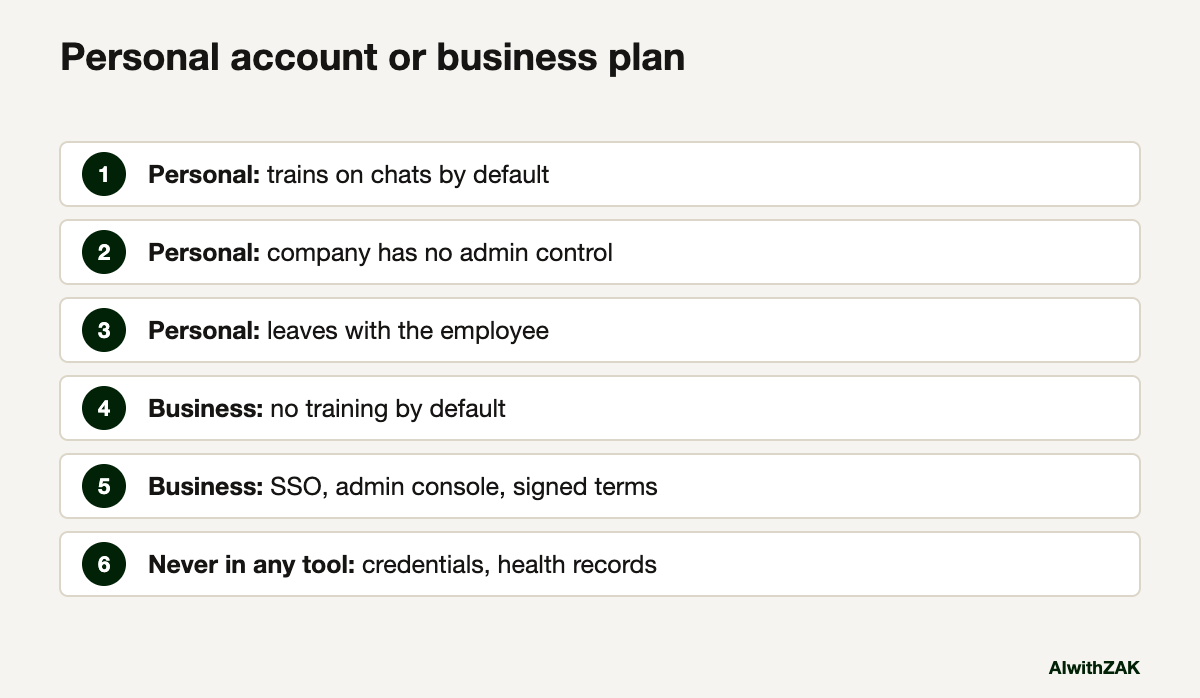
On a personal account, OpenAI’s Data Controls FAQ says conversations are used to train models by default. The setting is called “Improve the model for everyone,” under Settings, then Data controls. It is not a screen many people go looking for.
The bigger problem with personal accounts is ownership. When an employee leaves, their chat history, uploaded files and any custom GPTs leave with them, on an account you never controlled. That is the core of shadow AI in your company, and in my view it is a bigger exposure than a model training on one pasted paragraph.
What’s the difference between personal and business AI accounts?
Business accounts are excluded from model training by default, sit under a contract and data processing terms, and give an administrator control over who has access. Personal accounts generally train on conversations by default, follow consumer terms, and belong to the individual who signed up, not the company.
The pattern holds across all four major assistants. The table draws on OpenAI’s chat retention policy, Anthropic’s August 2025 consumer terms update and model training article, Google’s Gemini Apps Privacy Hub and Workspace privacy hub, and Microsoft’s Copilot privacy FAQ and enterprise data protection page, as they read in September 2026.
| Tool and plan | Trains on your chats by default? | Retention, per the vendor | Company admin control |
|---|---|---|---|
| ChatGPT Free, Plus, Pro | Yes, unless the user turns off “Improve the model for everyone” | Deleted chats scheduled for removal within 30 days; temporary chats kept up to 30 days | None |
| ChatGPT Business, Enterprise | No | Deleted conversations removed within 30 days unless legally required; Enterprise admins set retention | Yes: SSO, workspace admin, Enterprise audit logs |
| Claude Free, Pro, Max | Only if the user allows it in privacy settings | Up to five years if training is allowed, 30 days if not | None |
| Claude Team, Enterprise | No | Enterprise offers custom data retention | Yes: SSO, admin controls, Enterprise audit logs |
| Gemini app, personal Google account | Yes, and a subset of chats is read by human reviewers | Activity auto-deleted after 18 months by default; 72 hours with Keep Activity off; reviewed chats up to three years | None |
| Gemini in Google Workspace | Not outside your domain without permission, no human review | Governed by your Workspace settings | Yes, through the Workspace admin console |
| Microsoft Copilot, personal account | Yes, unless the user opts out | Per Microsoft’s consumer privacy terms | None |
| Microsoft 365 Copilot and Copilot Chat, work account | No, prompts and responses are not used to train foundation models | Your Microsoft 365 retention policies apply | Yes, through the Microsoft 365 admin centre |
So the honest answer to “is ChatGPT safe for company data” is mostly about the account type, and the same holds for the other three. Read the Gemini row twice. On a personal Google account, a sample of chats goes to human reviewers, and those reviewed chats can outlive your own deletion by up to three years. Nobody should be pasting payroll into that.
If you’re still choosing which of these to standardize on, ChatGPT, Claude, Copilot or Gemini for an Alberta business compares the business plans and prices.
How long does ChatGPT keep your conversations?
OpenAI says deleted chats on personal accounts are scheduled for permanent deletion within 30 days, and temporary chats are kept up to 30 days. Business workspaces follow the same 30-day deletion rule, and Enterprise admins can set their own retention period. Legal obligations can override all of these.
That last sentence is not boilerplate. In May 2025, as part of the New York Times copyright lawsuit, a US court issued a preservation order requiring OpenAI to preserve ChatGPT output logs that would otherwise have been deleted. The obligation ended on 26 September 2025 and the court terminated the order in October 2025, but logs already preserved stayed preserved, and accounts flagged by the Times remained subject to retention.
The lesson for an owner in Red Deer is narrow and practical. A vendor’s retention promise is a default, and a court in another country can suspend it without asking you. Treat anything you type into a cloud AI tool as something that could be kept longer than the settings page says, and decide what goes in on that basis.
What do Canadian privacy regulators say about using ChatGPT at work?
Canada’s federal privacy commissioner and its Alberta, BC and Quebec counterparts say organizations should use only AI tools that respect privacy law, enter personal information into prompts only where authorized, and remember that accountability for decisions stays with the organization, not the system.
Those lines come from the regulators’ principles for responsible generative AI, published 7 December 2023 and still the clearest guidance a Canadian business has. The May 2026 joint report on OpenAI pointed organizations back to the same document.
Underneath that guidance sit the laws you already answer to. Alberta’s Personal Information Protection Act, as Miller Thomson’s PIPA primer sets out, requires an organization to protect personal information in its custody or control by making reasonable security arrangements against unauthorized access, use and disclosure. Sending customer records to an AI vendor is a use and a disclosure. PIPEDA, the federal law, applies on top when personal information crosses provincial or national borders in the course of commercial activity, and a US-hosted AI tool usually means it does. AI regulation in Canada and Alberta maps the full set.
None of this makes a business plan illegal or a personal plan automatically unlawful. It means the question a regulator would ask is if you had the authority to put that information there and reasonable safeguards around it. A signed business agreement and an admin console are safeguards. An employee’s personal login is not.
What should never go into ChatGPT, even on a business plan?
Keep out anything a contract, a statute or your own judgment says must stay with you: health records under the Health Information Act, client material covered by a confidentiality clause that doesn’t allow subprocessors, passwords and access keys, and personal information you collected for a different purpose.
People who work in this field split here. One camp says a business plan with no-training terms, SOC 2 and encryption is as safe as any other SaaS tool you already trust with email and files, so treat it the same. The other says generative AI adds new exposure through connectors, memory features and legal holds, so keep sensitive categories out entirely.
If the first camp is right, your existing data classification applies and AI is one more approved system. If the second is right, you need a short list of categories that never go into any AI tool. Either way, you need that list in writing, and it has to fit on one page. My view sits closer to the first camp for ordinary business content and firmly with the second for the categories below.
- Health information. If you are a custodian under Alberta’s Health Information Act, AI use needs its own assessment. AI for Alberta clinics under the Health Information Act covers it.
- Client material under NDA. Read the confidentiality and subcontractor clauses first. Many prohibit sharing with third parties the client hasn’t approved.
- Credentials. Passwords, API keys, banking logins. Never, in any tool.
- Personnel files. Discipline notes, medical accommodations, compensation details for named people.
- Anything collected for another purpose. Customer data gathered to deliver a service doesn’t automatically come with consent to run it through an AI vendor.
A one-page rule set covering exactly this is what an AI acceptable use policy your team will follow is for, and the AI governance checklist shows where it fits with everything else.
So is ChatGPT safe for company data? On a company-owned business account with a written list of what stays out, yes. On an employee’s personal login, no, and the fix costs US$20 to US$25 a seat a month at OpenAI’s ChatGPT Business pricing as of September 2026. Buy the business plan before you write a single other rule.
Questions people ask
Not on ChatGPT Business, Enterprise or Edu, where OpenAI says it does not train on business data by default. On personal Free, Plus and Pro accounts, conversations are used for training unless the user turns off the “Improve the model for everyone” setting under Data controls. If staff use personal accounts for work, assume training is on.
It is designed for business use: no training on your data by default, AES-256 encryption at rest, TLS 1.2 or higher in transit, a SOC 2 Type 2 audit and single sign-on. That makes it suitable for most everyday confidential work. Material covered by a client confidentiality clause, health records and credentials need a separate decision regardless of the plan.
On a personal account, use Temporary Chat, which does not appear in history and is not used to train models, though OpenAI may keep it for up to 30 days for safety. Deleting a chat schedules it for permanent removal within 30 days. On ChatGPT Enterprise, the workspace administrator sets the retention period for the whole company.
Alberta’s Personal Information Protection Act does not ban it, but it requires consent or authority for the use and reasonable security arrangements to protect the information. Canada’s privacy commissioners advise entering personal information into prompts only where authorized. A business plan with signed terms is a safeguard; a personal account usually is not. This is not legal advice.
On 6 May 2026, the federal privacy commissioner and counterparts in Alberta, British Columbia and Quebec found that OpenAI’s original training of ChatGPT did not comply with their privacy laws, citing overcollection, consent, transparency and accuracy problems. The federal office called the complaint conditionally resolved after OpenAI’s commitments. Alberta’s commissioner called it well-founded and unresolved.
On business accounts, the commitments are broadly similar: Microsoft says Copilot prompts are not used to train foundation models, and Google says Workspace content is not used to train models outside your domain without permission. The larger difference is between business and personal accounts of any brand, since personal versions of all three generally train on conversations by default.
OpenAI lists Canada among its data residency regions, but only for new ChatGPT Enterprise and Edu workspaces and eligible API customers, as of September 2026. ChatGPT Business is not listed as eligible. If Canadian storage is a contractual requirement for you, confirm it in writing before you sign.