

Short answer. The Air Canada chatbot ruling, Moffatt v. Air Canada, 2024 BCCRT 149, decided 14 February 2024, is where British Columbia’s Civil Resolution Tribunal held Air Canada liable for negligent misrepresentation after its website chatbot gave a customer wrong information about bereavement fares. The tribunal rejected the argument that the chatbot was responsible for its own actions and awarded $812.02. For any Canadian business, the lesson is plain: what your chatbot or AI-drafted message tells a customer is treated as your statement.
Case details verified 23 September 2026 against the tribunal decision as reported by legal publishers. Not legal advice.
The Air Canada chatbot ruling started with a death in the family. In November 2022, Jake Moffatt’s grandmother died. He needed to fly from Vancouver to Toronto, so he went to Air Canada’s website and asked its chatbot about bereavement fares.
The chatbot told him he could book at the regular price and apply for the bereavement discount afterwards, within 90 days of the ticket being issued, using a refund form. He booked. He travelled. He applied.
Air Canada said no. Its actual policy, published on a different page of the same website, did not allow bereavement refunds for travel that had already happened.
Fifteen months later, in Moffatt v. Air Canada, 2024 BCCRT 149, a tribunal ordered the airline to pay him $812.02. The money was trivial for a company that size. The reasoning was not, and it applies to every Alberta business that has put a chatbot on its website or lets AI draft replies to customers.
What the Air Canada chatbot ruling says about liability
The case says a business is responsible for what its chatbot tells customers, as it is for any other page on its website. Air Canada argued the chatbot was a separate legal entity responsible for its own actions. The tribunal rejected that and found the airline liable for negligent misrepresentation.
Negligent misrepresentation, in plain terms, means you owed someone a duty to take reasonable care with what you told them, what you told them was wrong, they reasonably relied on it, and they lost money because of it. All four pieces were there.
Air Canada ran several defences. Its most talked-about argument was that the chatbot was “a separate legal entity that is responsible for its own actions.” Tribunal member Christopher C. Rivers, as Dentons summarized the decision, called that “a remarkable submission,” a phrase the UBC Law Review case comment also highlights. As CBS News reported, he wrote that “while a chatbot has an interactive component, it is still just a part of Air Canada’s website,” and that “it should be obvious to Air Canada that it is responsible for all the information on its website.” A static page or a chatbot, the tribunal said, makes no difference.
The airline also argued that the correct policy was available elsewhere on its site. The tribunal didn’t accept that either. As the American Bar Association’s summary of the decision puts the tribunal’s point, a consumer cannot be expected to double-check information found on one part of a website against another part.
The finding that matters most for owners, as McCarthy Tétrault’s summary puts it: Air Canada did not take reasonable care to make sure its chatbot was accurate.
How much did Air Canada have to pay?
Air Canada was ordered to pay $812.02: $650.88 in damages for the fare difference, $36.14 in pre-judgment interest and $125 in tribunal fees. Moffatt had claimed about $880. The damages equalled the gap between what he paid and what the bereavement fare would have cost him.
| Item | Amount |
|---|---|
| Damages for negligent misrepresentation | $650.88 |
| Pre-judgment interest | $36.14 |
| Civil Resolution Tribunal fees | $125.00 |
| Total | $812.02 |
My view: the $812 was the smallest cost in the case. The ruling was covered by news outlets and law firms across North America. For a regional business in Calgary or Red Deer, a similar story in a local Facebook group would cost more in trust than in dollars.
Does the Air Canada chatbot ruling apply to Alberta businesses?
Not directly. It is a British Columbia tribunal decision on a small claim, and it does not bind Alberta courts. The reasoning, though, is ordinary negligent misrepresentation law that exists across Canada, and Alberta’s Consumer Protection Act separately prohibits stating a price, benefit or discount that does not exist.
Lawyers read the case two ways. One camp treats it as a narrow result on specific facts, a small claim that is not binding on other tribunals or judges. The other treats it as the first clear Canadian signal of how courts will handle AI that talks to customers.
If the narrow reading is right, you still carry the ordinary legal risk of any wrong statement your business makes, chatbot or not. If the signal reading is right, expect later decisions to build on it. Either way, the practical move is identical: treat anything your AI says to a customer as something you said, and check it with the same care.
Alberta adds its own layer. Service Alberta’s guidance on the Consumer Protection Act’s unfair practices lists “stating a price, benefit or discount that does not actually exist” and notes that consumers cannot waive their rights under the Act. A chatbot that invents a discount is close to the textbook case. I’m not a lawyer, and this is not legal advice. If your chatbot handles prices, refunds or warranty terms, it is worth an hour with counsel.
The wider picture of which laws already govern AI use in Alberta covers privacy and human rights obligations that sit alongside this.
Does a disclaimer protect you if your chatbot is wrong?
Don’t count on it. The tribunal held that customers cannot be expected to cross-check a chatbot against other pages, and Alberta’s consumer law says consumers cannot waive their rights. A disclaimer may help at the edges, but the dependable protection is a chatbot that only says what you have approved.
It is tempting to add a line reading “AI can make mistakes, please verify important information.” That line is fine to have. It is a weak thing to build your defence on, because the tribunal’s logic points the other way: the business put the tool in front of the customer, so the business carries the care.
The stronger design choice is grounding, meaning the chatbot answers only from documents you supply, such as your published policies, rather than from whatever the model generates on its own. When the answer isn’t in those documents, the chatbot says so and hands the customer to a person. The plain explanation of RAG covers how that works.
My position is firm on one point. A chatbot that can quote a price, a refund rule, a warranty term or a delivery date should read that answer from a page a person approved. It should never compose one.
Illustrative example, not a client case study. Picture a Lethbridge equipment rental company whose website chatbot is asked if the damage waiver covers hail. The waiver document says it doesn’t. The chatbot, trained on general text about equipment rental, says it does. A customer skips buying separate coverage, a July storm dents the unit, and the customer has a screenshot. Under the reasoning in Moffatt, the rental company would have a hard time arguing that its chatbot spoke for itself.
A checklist for any Alberta business using a chatbot or AI-written replies
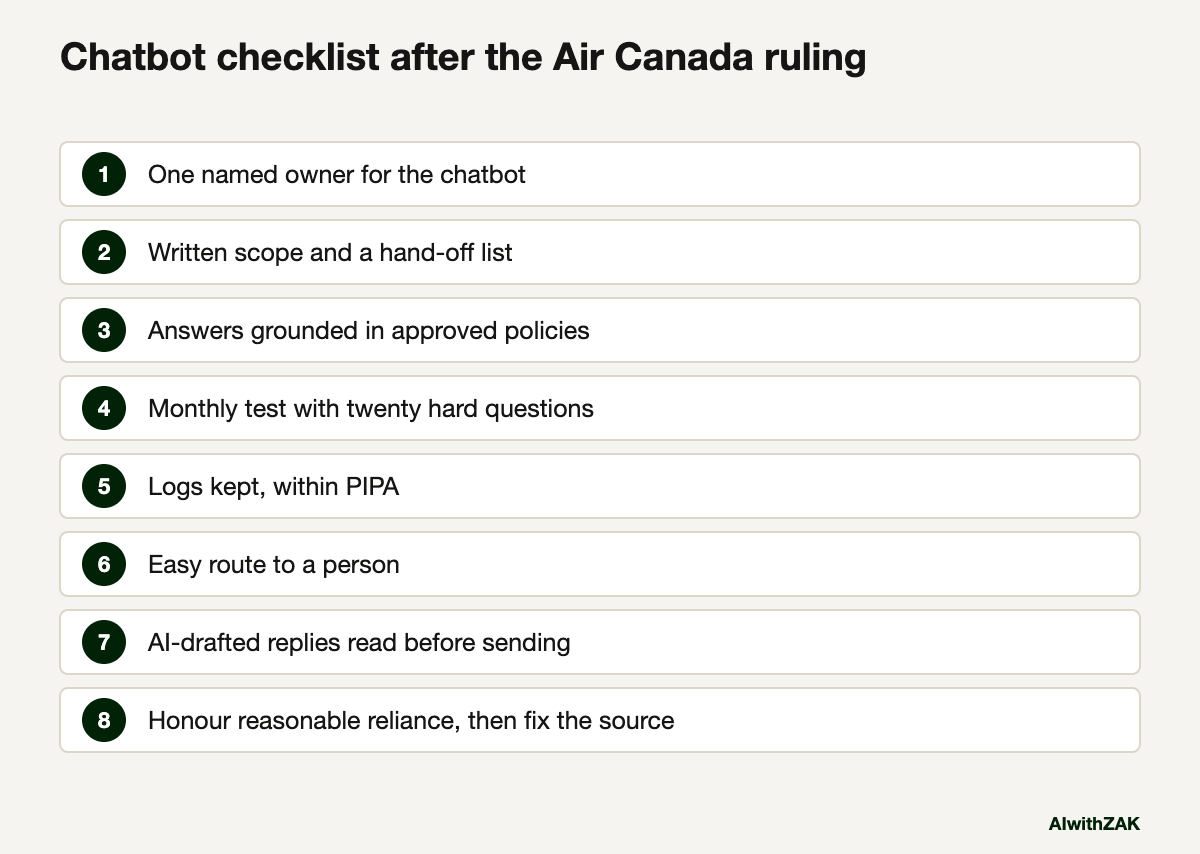
Treat every customer-facing AI output as a company statement. Limit what the chatbot may answer, ground it in approved documents, route pricing, refund and policy questions to people or to fixed text, test it monthly with hard questions, keep logs, and name one person responsible for its accuracy.
This applies to AI-drafted emails and text replies as much as to a chat widget. If a staff member sends a customer an AI-written answer about a refund without reading it, the same logic follows.
| Check | What good looks like |
|---|---|
| One named owner | A specific person is responsible for what the chatbot says, reviews its logs and signs off on changes. |
| Scope written down | A short list of topics the chatbot may answer and a list it must hand to a person, with pricing, refunds, warranties, legal and safety on the hand-off list unless answered from fixed text. |
| Grounded answers | The chatbot answers from your current published policies and says “I don’t know” when the answer isn’t there. |
| One source of truth | When a policy page changes, the chatbot’s documents change the same day. Someone owns that step. |
| Monthly hard-question test | Twenty awkward questions, including ones designed to tempt it into promising a discount or exception, run every month with results saved. |
| Logs kept | Conversations are stored long enough to see what a customer was told, consistent with your privacy obligations under PIPA. |
| Easy route to a person | A customer can reach a human from any chatbot conversation without starting over. |
| AI-drafted messages reviewed | Staff read and own any AI-drafted reply before it goes to a customer, especially on money, dates or commitments. |
| Vendor terms read | Someone has read the liability clause and knows what your chatbot vendor accepts responsibility for, and what it leaves with you. |
| Error plan | When the chatbot gets something wrong, you honour reasonable reliance first and fix the source second. |
That last row is my opinion, and it is the cheapest lesson in the case: honouring a customer’s reasonable reliance early usually costs less than defending a wrong answer later.
If you are choosing a tool, the questions to ask an AI vendor before you sign include liability and logging. If you are still deciding what kind of tool you need, the difference between a chatbot and an AI agent matters here, because an agent that can act, not only talk, raises the stakes again. The rules for what an AI agent may do without asking pick up where this checklist stops.
Put one person’s name next to your chatbot this week. Everything else on the checklist follows from somebody owning it.
Questions people ask
In Moffatt v. Air Canada, 2024 BCCRT 149, Air Canada’s website chatbot told a grieving customer he could claim a bereavement fare discount after travel. The actual policy did not allow that. British Columbia’s Civil Resolution Tribunal found Air Canada liable for negligent misrepresentation on 14 February 2024 and ordered it to pay $812.02.
The Moffatt decision says yes, at least in that case. The tribunal held that a chatbot is part of the company’s website and that the company is responsible for all information on it. The decision is from a British Columbia tribunal and does not bind other courts, but it applies ordinary negligent misrepresentation principles found across Canada.
Yes. Air Canada argued the chatbot was a separate legal entity responsible for its own actions. The tribunal member called it a remarkable submission and rejected it, finding that the chatbot was simply part of Air Canada’s website and that information from a chatbot carries the same responsibility as information on a static page.
$812.02 in total. That was $650.88 in damages for the difference between the fare paid and the bereavement fare, $36.14 in pre-judgment interest and $125 in Civil Resolution Tribunal fees. The customer had claimed about $880. The amount was small, but the reasoning behind it is what businesses cite.
A disclaimer is unlikely to be enough on its own. The tribunal said customers cannot be expected to double-check a chatbot against other pages, and Alberta’s Consumer Protection Act says consumers cannot waive their rights. Safer design limits what the chatbot answers, grounds it in approved documents and hands pricing and policy questions to people.
It is not binding in Alberta, since it came from a British Columbia small-claims tribunal. Its reasoning rests on negligent misrepresentation, a common law principle that Alberta courts also apply. Alberta’s Consumer Protection Act also treats stating a price, benefit or discount that does not exist as an unfair practice. Get legal advice for your own situation.