


Short answer. This AI glossary for business defines 40 terms an Alberta owner will hear in vendor pitches, staff questions and board meetings, from agent to zero data retention. Each entry gives a plain-English definition in a sentence or two and one line on why it matters to someone running a company. The terms that matter most in 2026 are agent, context window, hallucination, prompt injection, RAG and shadow AI, because they decide what AI can safely do inside your business.
Definitions and cited facts verified 23 September 2026.
Sit through enough AI sales demos and you’ll hear “agentic RAG pipeline with MCP connectors” said with a straight face to the owner of a 40-person HVAC company in Red Deer. That sentence is the whole case for an AI glossary for business.
Every word in that phrase means something real. Most owners in the room can’t tell which parts matter to them and which are decoration, and nobody in the pitch is going to stop and define them.
So here are 40 terms, defined the way I would explain them across a table. Send it to whoever sits on your side of the next vendor call.
What does an AI glossary for business need to cover?
A useful AI glossary for business covers the words that change a decision: what a tool can do, what it can see, what it costs and what can go wrong. It skips the research vocabulary an owner will never need, and it says plainly why each term matters to a company.
These 40 come up in proposals, pricing pages, privacy policies and staff questions. You won’t find “backpropagation” here. You do need to know a chatbot from an agent before someone sells you one dressed up as the other.
The AI glossary for business, A to Z
The 40 terms below run alphabetically from agent to zero data retention. Each has a one or two sentence definition and a line on why an owner should care. Where a term has a fuller explanation elsewhere on this site, the entry links to it.
A
Agent. An AI system that can take actions toward a goal, such as reading an inbox, updating a spreadsheet or booking a job, rather than only answering questions. Why you care: an agent can make mistakes that cost money, so it needs permissions set as carefully as a new employee’s. See what to settle before an AI agent gets a password.
AGI (artificial general intelligence). A hypothetical AI able to match people across almost any mental task. There is no agreed test for it. Why you care: the word shows up in headlines and pitches, and it tells you nothing about how well a product fits your business.
API (application programming interface). A defined way for one piece of software to talk to another. AI vendors sell model access through APIs, usually priced per token. Why you care: API use often carries different data terms from the chat app, sometimes stricter, so read both.
Automation. Software that follows fixed rules to do a task without a person, such as moving form entries into your CRM. Why you care: plenty of problems sold as AI projects are cheaper, more reliable automation jobs. AI agents versus automation explains the split.
C
Chatbot. A program that answers messages in conversation. Modern ones run on a large language model; older ones follow scripts. Why you care: a chatbot on your website speaks for your company, and in 2024 a BC tribunal, in Moffatt v. Air Canada, held the airline responsible for what its bot told a customer.
Connector. A link that lets an AI assistant read from or act in another system, such as SharePoint, Google Drive, Slack or your accounting software. Why you care: every connector widens what the AI can see, so each one should be a deliberate decision.
Context window. How much text a model can hold in mind at once, measured in tokens. Anthropic’s current Claude Opus 5.5 and Sonnet 5 models take one million tokens, per its models overview. Why you care: it decides if you can hand the AI a whole contract or only pieces of it.
Copilot. Microsoft’s brand for its AI assistants, and also a loose industry word for any assistant that works alongside a person inside their software. Why you care: ask which product and which licence a vendor means.
D
Data residency. Where your data is physically stored. OpenAI, for example, lists Canada as a data residency region for new ChatGPT Enterprise and Edu workspaces. Why you care: some client contracts and public-sector work require Canadian storage.
Deep research. A mode in several AI assistants that runs many searches over several minutes and writes a longer, cited report. Why you care: it saves hours of desk research, but a person still checks its sources.
E
Embedding. A list of numbers that represents what a piece of text means, so a computer can find passages with similar meaning even when the words differ. Why you care: embeddings are how an assistant finds the right page in your documents.
Evals (evaluations). A fixed set of test questions with known good answers, run against an AI system to measure quality. Why you care: without evals, “it seems to work” is your only quality standard.
F
Fine-tuning. Further training of an existing model on your own examples to change its style or behaviour. Why you care: it is slower and costlier to update than looking information up, so for answering from company documents it is rarely the right first step.
Foundation model. A large, general-purpose model trained on broad data, such as those from OpenAI, Anthropic and Google, that other products are built on. Why you care: many AI products are a foundation model plus a user interface, so find out whose model sits underneath.
G
Generative AI. AI that produces new content, text, images, audio or code, in response to a prompt. Why you care: it is the category behind ChatGPT, Claude, Copilot and Gemini, and most workplace AI decisions in 2026 are about it.
Governance (AI governance). The rules, roles and checks a company uses to decide which AI tools are allowed, what data they may touch and who is accountable. Why you care: privacy law already holds you responsible. See AI governance for Canadian businesses.
Grounding. Tying an AI answer to specific source material, such as your documents or a web search, instead of the model’s general memory. Why you care: grounded answers can be checked against a source. Ungrounded ones can’t.
Guardrails. Rules and filters that limit what an AI system will say or do, such as refusing to quote prices or escalating complaints to a person. Why you care: guardrails are what stop a customer-facing bot from promising something your company can’t deliver.
H
Hallucination. A confident answer that is false, such as an invented statistic, citation or policy. Why you care: hallucinations sound exactly like correct answers, so anything going to a client, a regulator or a contract needs a person to check it.
Human in the loop. A design where a person reviews or approves an AI output before it takes effect. Why you care: Canada’s privacy commissioners, in their generative AI principles, say accountability for decisions rests with the organization, not the automated system, so decide where a person signs off.
I
Inference. The act of running a trained model to get an answer. Each question you ask is an inference. Why you care: inference is what you pay for on usage-based pricing, so heavy use can move a monthly bill a long way.
L
Large language model (LLM). A model trained on huge amounts of text to predict and generate language. It is the engine inside ChatGPT, Claude, Copilot and Gemini. Why you care: an LLM knows public text up to a cut-off date and nothing about your company unless you supply it.
M
Machine learning. Software that learns patterns from data instead of following hand-written rules. Generative AI is one branch of it. Why you care: older machine learning, such as demand forecasting or fraud scoring, is often the better fit for numeric problems.
MCP (Model Context Protocol). An open standard, released by Anthropic in November 2024, for connecting AI assistants to the systems where data lives. Why you care: when a vendor says their tool “supports MCP,” it means it can plug into other software more easily, which also means more access to govern.
Memory. A feature that lets an assistant remember facts about you or your work across separate conversations. Why you care: sensitive details can persist longer than anyone intended.
Multimodal. A model that handles more than one kind of input or output: text, images, audio, video. Why you care: a site photo, scanned invoice or voice note can go straight in without retyping.
O
Open-weight model. A model whose trained parameters are published so anyone can download and run it on their own servers. Why you care: it can keep data entirely in-house, but you then carry the hosting, security and upkeep yourself.
P
PIPA. Alberta’s Personal Information Protection Act, the privacy law for most private-sector organizations in the province. It requires reasonable security arrangements for personal information. Why you care: putting customer or employee data into an AI tool is a use and a disclosure under it.
PIPEDA. The federal private-sector privacy law. In Alberta it applies when personal information crosses provincial or national borders in the course of commercial activity. Why you care: a US-hosted AI tool can bring PIPEDA into play alongside PIPA. See AI regulation in Canada and Alberta.
Project (custom GPT, Gem). A saved workspace inside an AI assistant with its own instructions and reference files. OpenAI, Anthropic and Google each have a version. Why you care: it is the cheapest way to stop staff pasting the same background into every chat.
Prompt. The instruction or question you give an AI model. Why you care: a prompt with context, an example and the format you want beats a one-line request, and staff can learn it in an afternoon.
Prompt injection. An attack where hidden instructions in an email, web page or document hijack what an AI does. OWASP ranks it the top risk for applications built on language models. Why you care: an agent that reads your inbox can be told to do things by whoever emails you.
R
RAG (retrieval-augmented generation). A method where the system searches your documents first, then has the model answer from what it found. Why you care: it is how an assistant answers from your own manuals and policies. See what RAG is and when a business needs it.
Reasoning model. A model that works through a problem in steps before answering, taking longer in exchange for better results on hard tasks. Why you care: use it for analysis and planning, not quick drafting.
S
Shadow AI. AI tools staff use for work without company approval, usually on personal accounts. Why you care: company data ends up on accounts you don’t control and can’t recover when someone leaves. See shadow AI in your company.
System prompt. Standing instructions set behind the scenes that shape how an assistant behaves in every conversation, such as tone, rules and what to refuse. Why you care: on a customer-facing tool, the system prompt is effectively your policy manual for the bot.
T
Token. The unit models read and bill in. OpenAI’s rule of thumb is that one token is about three-quarters of an English word. Why you care: context windows and usage-based prices are both counted in tokens, so this is how you estimate cost.
Training data. The text, images and other material a model learned from. Why you care: consumer AI plans often use your conversations as training data by default, and business plans generally don’t, which is the main reason to pay for the business version.
V
Vector database. A database built to store embeddings and find passages with similar meaning quickly. Why you care: only relevant if you build your own document search.
Z
Zero data retention. A vendor arrangement where your prompts and outputs aren’t kept after processing. OpenAI’s API data controls offer it only to qualifying customers with prior approval; its default keeps abuse-monitoring logs up to 30 days. Why you care: if a contract demands it, get it confirmed in writing.
Which AI terms do vendors use loosely?
Agent, AGI, copilot and RAG are the four most stretched words in AI sales. Each has a real meaning, and each gets attached to products that don’t meet it. Ask what the product actually does, what it can access and how it was tested before accepting the label.
“Agent” is the worst offender. A scheduled script that emails a summary is automation. It becomes an agent when it decides what to do next and can act in your systems. The difference matters because the second one needs permissions, logging and someone accountable.
| Word in the pitch | What it might really be | Question to ask |
|---|---|---|
| AI agent | A fixed automation with a chat window | What decisions does it make on its own, and what can it change in our systems? |
| Trained on your data | Your files loaded into a RAG index or a project | Is the model retrained, or does it look documents up? Where are they stored? |
| No hallucinations | A grounded system that still makes errors | What is your measured error rate on questions like ours? |
| Enterprise-grade security | Anything from SOC 2 Type 2 to a login page | Can we see the audit report and the data processing terms? |
| Our own AI model | A foundation model from a large vendor underneath | Whose model is it, and whose data terms apply? |
Those questions, and the answers worth hearing, are laid out in full in the questions to ask an AI vendor before you sign.
Which AI terms should your whole team know?
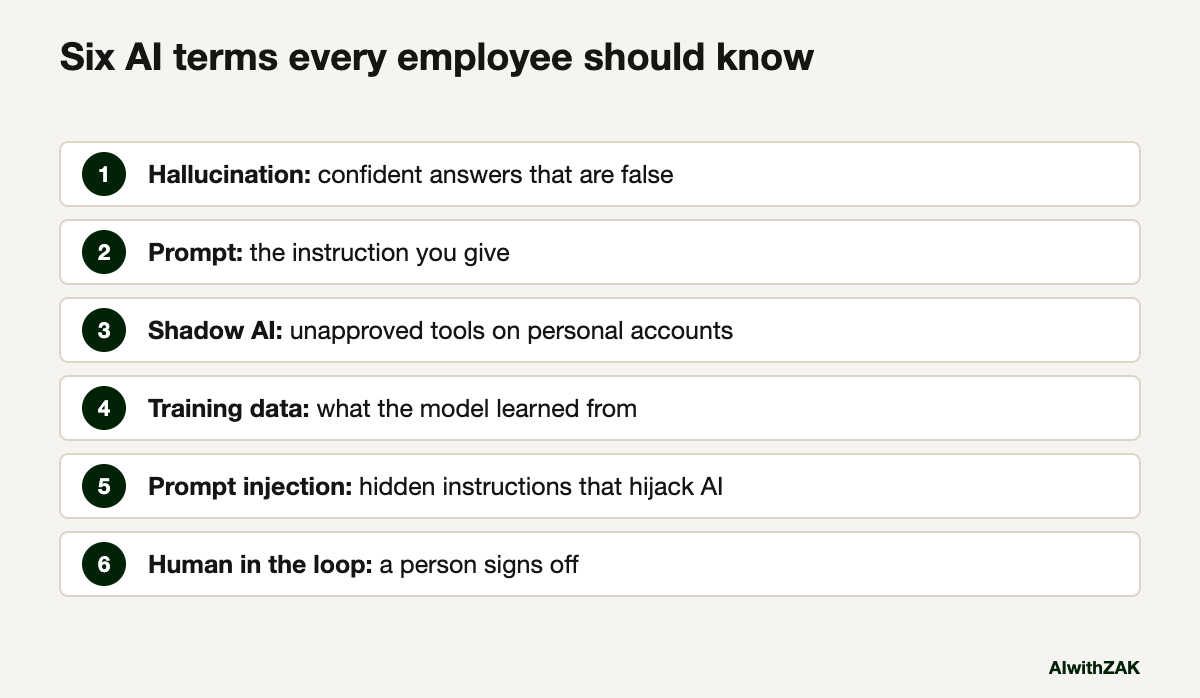
Everyone on staff should know six terms: hallucination, prompt, shadow AI, training data, prompt injection and human in the loop. Those six cover the mistakes ordinary employees can make on an ordinary Tuesday. The rest can stay with whoever owns AI in your company.
Put those six on the first page of your AI policy and in the first half-hour of any training. They explain why a person checks the output, why work stays on company accounts and why an assistant shouldn’t act on instructions buried in an email. Building an AI-ready workforce covers the training side, and a one-page acceptable use policy is the place to put them.
Learn the six first. The other 34 can wait until someone tries to sell you one.
Questions people ask
AI is the broad field of software that performs tasks needing human-like judgment. Machine learning is the part of AI that learns patterns from data instead of following written rules. Generative AI is the branch of machine learning that produces new text, images, audio or code, and it is what powers ChatGPT, Claude, Copilot and Gemini.
An AI agent is an AI system that can take actions toward a goal, not only answer questions. It might read an inbox, decide which messages need a reply, draft them and file the rest. Because it acts inside your systems, it needs clear permissions, logging and a person accountable for what it does.
A hallucination is a confident answer from an AI model that is false, such as an invented statistic, a fake citation or a policy that doesn’t exist. It reads exactly like a correct answer, which is why anything going to a client, a regulator or into a contract should be checked by a person before it is used.
A token is the unit AI models read, write and bill in. OpenAI’s rule of thumb is that one token is about three-quarters of an English word, so 100 tokens is roughly 75 words. Context windows and usage-based API prices are both measured in tokens, which makes them the basis for estimating cost.
A context window is how much text an AI model can hold in mind at once, including your instructions, documents and the conversation so far. It is measured in tokens. Anthropic’s current Claude Opus 5.5 and Sonnet 5 models take one million tokens, enough for several long contracts in a single conversation.
Prompt injection is an attack where hidden instructions inside an email, web page or document take over what an AI system does. OWASP lists it as the top risk for applications built on language models. A small business should care as soon as an AI tool can read incoming email or browse the web and also take actions.
Start with six: hallucination, prompt, shadow AI, training data, prompt injection and human in the loop, because they cover the everyday risks. Owners buying or governing AI should add agent, context window, RAG, connector, data residency and evals, since those decide what a tool can see, do and be trusted with.