
Short answer. AI for Alberta real estate is safest on first drafts: listing descriptions, social posts, lead follow-ups, market updates, transaction checklists and condo document summaries. The licensee stays responsible for every word. RECA’s advertising standards apply to AI-written copy exactly as they apply to anything else: the brokerage name as licensed, nothing capable of misleading a reasonable consumer, and written authorization before advertising a property. Check every fact against the listing, label altered photos, and keep client personal information out of consumer AI accounts.
Rules, guidance and market figures verified 23 September 2026. Not legal advice.
The first rule of AI for Alberta real estate is simple: a listing description written by ChatGPT is still your advertising. The province’s rules don’t mention AI, and they don’t need to.
The Real Estate Council of Alberta’s advertising guidelines say an ad must not be “false, inaccurate, capable of misleading the recipient or intended recipient, in bad taste or offensive.” They go further: “advertising can be misleading even if there is no proof a consumer was misled.” The test is what a reasonable consumer could take from it. Section 42(a) of the Real Estate Act Rules separately covers representations that mislead or deceive any person.
Now picture what a language model does with a thin set of listing notes. It fills gaps. It adds the word “renovated” because renovated kitchens show up in a lot of listings. It puts the house “steps from” a park that is a 15-minute walk away. Nobody checked that draft, and it goes out with your name on it.
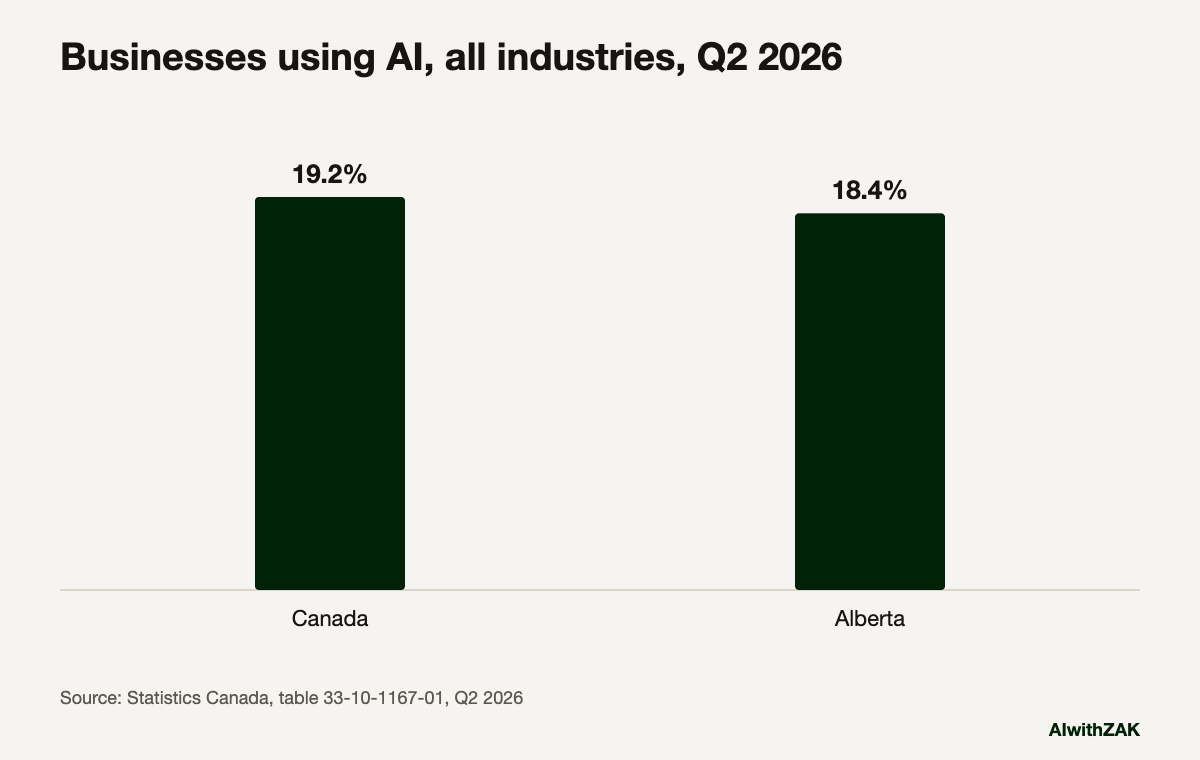
The time matters more this year. CREB’s August 2026 figures showed Calgary sales down about 16% from a year earlier and the benchmark price down about 1%. Across all industries, only 18.4% of Alberta businesses reported using AI in Statistics Canada’s second quarter 2026 survey, against 19.2% nationally, a number I’ve set against the province’s AI data centre build. Real estate can raise it, as long as the rules come first.
I’m not a lawyer, and this isn’t legal advice. It’s a map of what applies, so you know which questions to take to your broker or to RECA.
What can AI for real estate agents in Alberta safely do?
AI for real estate agents in Alberta is safe and useful for first drafts: listing copy, social posts, follow-up emails, market updates, deadline lists and condo document summaries. The agent checks every claim against the source before anything goes out. The drafting is the AI’s job. The accuracy stays yours.
| Use case | What it replaces | What it needs | First step |
|---|---|---|---|
| Listing description drafts | Writing each description from scratch | Your own listing sheet and notes, not a guess | Feed the model only verified facts and ask it to flag any claim it can’t trace to them |
| Social posts and ads | Writing captions for every new listing and open house | Seller authorization and the brokerage name exactly as licensed | Build a caption template with the brokerage name fixed in it |
| Lead follow-up drafts | Leads from the weekend waiting until Wednesday | A CRM or inbox the agent checks daily | Draft replies to every new lead within the hour, with the agent sending each one |
| Monthly market updates | Rewriting board statistics into a client newsletter | The board’s published monthly figures | Have AI summarize the month for one neighbourhood, then check every number against the source |
| Transaction deadline tracking | Condition dates kept in a head or on a sticky note | The signed purchase contract | Extract every date and condition into a checklist and compare it line by line with the contract |
| Condo document summaries | Reading hundreds of pages of bylaws, minutes and reserve fund studies | The full document package | Ask for a list of issues with page references, then read those pages yourself |
| Brokerage policy questions | Agents calling the broker about the same policy points | The brokerage’s written policy manual | Load the manual into a shared AI project and test it on ten real questions |
The condo row carries the most risk. A summary that misses a special assessment in the minutes is worse than no summary, because it creates confidence.
What do RECA’s advertising rules mean for AI-written listings?
RECA’s advertising rules apply to AI-written copy with no exceptions. Every ad must clearly show the brokerage name as it appears on the brokerage’s licence, must not be capable of misleading a reasonable consumer, and needs written authorization from the owner before a property is advertised.
Four points from RECA’s advertising guidelines matter most when a model is doing the drafting.
1. The brokerage name. It must appear as it does on the brokerage’s licence, unabbreviated, in all of the licensee’s own advertising, and on social media profiles used for business. A logo or a website address doesn’t count. A model may shorten a long name to fit a caption, so fix the name in your template and never let the model write it.
2. The misleading test. The general impression counts, as well as the literal words. A model’s habit of adding appealing adjectives is exactly what this test catches.
3. Seller authorization. Written authorization from the owner comes before any ad, AI-drafted or not.
4. Sold advertising. Where a sold post reveals personal information, such as interior photos or the price, the guidelines lean toward getting consent from the parties. An AI tool that turns every closing into a social post needs that step built in.
Section 51(1)(c) of the Real Estate Act Rules puts the brokerage name duty on the broker as well. That makes an agent’s AI habits a brokerage problem, which is why the policy question later in this piece matters.
Can you use AI virtual staging on an Alberta listing?
I found no Alberta-wide rule that bans virtual staging or sets one disclosure format. The misleading-advertising test still applies to every image. My position: label every staged or AI-altered photo on the image itself, keep the original in the listing, and check your board’s current rules first.
Furniture dropped into an empty living room is one thing. Removing a power line, replacing a grey sky, or “fixing” a cracked driveway is another. The first shows potential. The rest can hide a defect a buyer would care about, and that’s where the misleading test bites.
Short version: stage the furniture, never the house.
Where AI doesn’t help realtors yet
AI is weak at pricing a specific home, reading a buyer in a showing, negotiating, and knowing a street the way an agent who has sold on it does. It can write up comparables you choose. It can’t smell the basement or sit in traffic on Crowchild at five.
Don’t let a model suggest a list price. It has never seen the house and will produce a confident number anyway.
Chatbots on a brokerage website are the other trap. A bot that promises a showing time, a commission rate or a fact about a property is speaking for you. What the Air Canada chatbot ruling means for your business explains why a company can be held to what its bot says. If you still want one, customer service automation that works shows how to keep it to questions it can answer from your own material.
What should an Alberta real estate brokerage put in its AI policy?
A brokerage AI policy should list the approved tools, ban client personal information in consumer accounts, require a licensee to verify every AI-drafted fact, set rules for altered images, and say when clients are told AI was used. RECA hasn’t published AI-specific guidance, so neighbouring regulators are the best model.
When I checked in September 2026, I couldn’t find AI-specific guidance from RECA. Two bodies have published something worth borrowing.
British Columbia’s regulator, the BC Financial Services Authority, issued an artificial intelligence guideline on 22 February 2024. It isn’t Alberta law. It tells licensees to verify AI output, get clients’ informed consent before putting their information into an AI tool, and tell clients when AI is being used. Brokerages are expected to set policy, train and supervise. The Canadian Real Estate Association frames its own AI guidance around transparency, accuracy and accountability, and points REALTORS® back to the advertising articles of the REALTOR® Code.
Two Alberta laws round it out. The Personal Information Protection Act governs what you do with client information, so buyer pre-approval letters and seller financial details stay out of free AI accounts. Is it safe to put company data into ChatGPT covers the settings. The Alberta Human Rights Act applies to tenancy, so any AI used to screen rental applicants needs a person reviewing every decision.
If you’re writing the policy from scratch, the AI acceptable use policy template gives you the one-page structure, and finding the shadow AI already in use tells you what’s already happening among your agents.
Illustrative example, not a client case study. Picture a 12-agent Calgary brokerage where some agents already use free chatbots for listing notes. The broker picks one business AI plan, writes a one-page policy, and builds a listing template with the brokerage name fixed. After a month, the broker spot-checks ten AI-drafted listings against their notes and counts the claims that can’t be traced.
Paste this into your AI. Use this after the model drafts a listing description. It turns the tool into its own fact-checker. Leave out seller names and anything personal.
Below are two things: my verified listing notes, and a draft listing description.
Compare the draft against the notes line by line.
1. List every claim in the draft that does not appear in the notes, including adjectives like "renovated", "updated", "steps from" or "sunny backyard".
2. List any distances, measurements, years or features that differ from the notes.
3. Rewrite the description using only facts from the notes. Do not add the brokerage name; I will add it myself.
NOTES:
[paste your listing notes]
DRAFT:
[paste the draft]
AI will make Alberta agents faster at the writing. The part of the job that keeps its value is reading every draft as a claim you’re about to sign.
Questions people ask
Yes. No Alberta rule bans it. The licensee remains responsible for the ad, which must include the brokerage name as licensed and must not be capable of misleading a reasonable consumer under RECA’s advertising standards. Give the model only verified facts, and check every claim in the draft against your listing notes before publishing.
RECA had not published AI-specific guidance when checked in September 2026. Its existing advertising guidelines and the Real Estate Act Rules apply to AI-written content the same way they apply to any advertising, including the ban on misleading representations and the requirement to show the brokerage name clearly.
No Alberta-wide rule bans it or sets one disclosure format. RECA’s standard that advertising must not be capable of misleading a reasonable consumer still applies to every image. Label staged or altered photos on the image, keep the original in the listing, never hide defects, and check your board’s current rules.
RECA’s guidelines require the brokerage name exactly as it appears on the brokerage’s licence, unabbreviated, in all of a licensee’s own advertising, including social media profiles used for business. Licensees also need written authorization from the owner or their lawful representative before advertising a property, and permission before advertising another licensee’s listing.
Be careful. Alberta’s Personal Information Protection Act governs how you collect, use and disclose client personal information. Keep names, financial details and pre-approval letters out of free consumer AI accounts. BC’s regulator tells its licensees to get clients’ informed consent first, which is a sensible standard to borrow in Alberta.
Not reliably. A general AI model can’t see the property, doesn’t know its condition, and will still give a confident number. Use your own comparable sales and judgment to price, then use AI to write up the comparables and explain the reasoning to the seller in plain language.
CREB’s August 2026 figures showed City of Calgary sales down about 16% from August 2025, new listings down nearly 10%, and the benchmark price down about 1%. CREB’s monthly statistics package has the full breakdown by property type and district.