

Short answer. AI data residency matters, but less than most vendors’ marketing suggests and more than most owners assume. Data residency means your data is stored, and sometimes processed, in Canada. It does not by itself protect data from US legal demands, because the US CLOUD Act reaches data a US provider controls wherever it sits. Canadian privacy law allows data to leave Canada if you stay accountable and tell people. Decide by data type: sensitive or contract-restricted data needs Canadian storage or Canadian control; routine work usually doesn’t.
Vendor options and law verified 23 September 2026. Not legal advice.
The clearest recent lesson on AI data residency came from a hearing room in Paris. On 18 June 2025, at a French Senate inquiry into public procurement and digital sovereignty, Microsoft France’s director of public and legal affairs was asked to guarantee under oath that French citizens’ data could not be handed to the US government without French approval.
“No, I cannot guarantee that,” Anton Carniaux answered, “but, again, it has never happened before.”
Both halves of that sentence matter. Microsoft also said it has not received US government requests for data held on its servers in Europe. The honesty of the first half made headlines anyway, because it said out loud what US law has said since 2018: where a server sits and who can be compelled to open it are two separate questions.
For an Alberta business deciding which AI tool gets its client files, that distinction is the whole topic. Canadian storage is now available from several major AI vendors. Canadian processing is patchier. Canadian control is rarer still.
What does AI data residency in Canada actually mean?
AI data residency in Canada means a vendor commits to keeping your data in Canadian data centres. Check which data it covers. Storage of saved chats and files is one commitment. Processing, where the model reads your prompt and writes its answer, is a separate one, often done elsewhere.
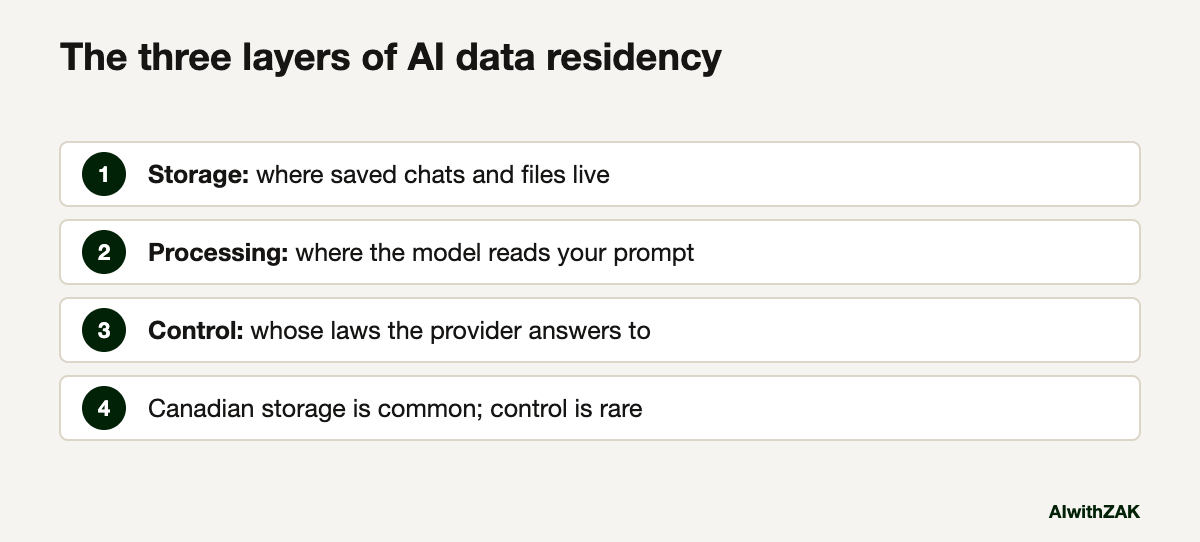
There are three layers worth separating whenever a vendor says “Canadian data residency.”
1. Storage. Where your conversations, uploaded files and logs are kept when nobody is using them. This is the layer most Canadian residency offers cover.
2. Processing. Where inference happens, meaning the moment the model actually reads your prompt and generates a response on a server full of chips. Your data exists in that server’s memory for that moment. Several vendors store in Canada but process elsewhere.
3. Control. Which country’s laws the company running the servers answers to. A US-headquartered company running a Toronto data centre is still a US company. Data sovereignty, as the term is usually used, is about this layer.
Most confusion comes from treating the first layer as if it delivered the third.
Does the US CLOUD Act reach data stored in Canada?
It can. The CLOUD Act, signed on 23 March 2018, requires US providers to disclose data in their possession, custody or control regardless of where it is stored. Data in a US company’s Canadian data centre is within reach. Some orders can be challenged, but location is no shield.
The CLOUD Act was passed in response to a court fight over emails Microsoft stored in Ireland. The law settled that fight by saying location doesn’t decide access: a provider’s obligations stay the same wherever the data sits, inside or outside the United States. It added a way for providers to ask a court to quash an order on comity grounds, meaning respect for another country’s laws, but that route is only available where the US has a formal data-sharing agreement with the other country.
Canada’s own government reached the same conclusion years ago. Its white paper on data sovereignty and public cloud, first published in 2018 and last updated in April 2026, says the stored data “may be subject to the laws of other countries” regardless of where cloud resources are located, and that as long as a provider operating in Canada is subject to foreign law, “Canada will not have full sovereignty over its data.” It names the US Foreign Intelligence Surveillance Act as the primary risk.
The federal government’s answer for its own data was practical, not absolute: limit which categories of data go to public cloud, encrypt everything with keys the government alone controls, and require providers by contract to disclose access attempts. Those three moves translate well to a private business, and they sit comfortably alongside the other rules that already govern AI in Alberta.
Can an Alberta business legally use AI that stores data in the US?
Generally yes. Neither PIPEDA nor Alberta’s PIPA bans sending personal information outside Canada for processing. Both require you to stay accountable, protect it by contract, and be open about it. PIPA adds specific policy and notice requirements when a service provider outside Canada handles personal information.
The federal privacy commissioner’s guidelines on processing personal data across borders are blunt on two points. PIPEDA “does not prohibit” transfers to another jurisdiction for processing. And no contract can override the laws of the country the data goes to, so organizations should tell people their information may be accessed by that country’s courts, law enforcement and national security authorities.
Alberta goes a step further for private-sector organizations. Under PIPA, if you use a service provider outside Canada to collect, use or disclose personal information, your written policies must name the countries where that happens and the purposes the provider is authorized for. People must be told how to get access to those policies, and given the name or title of someone who can answer their questions.
If your privacy policy doesn’t mention the AI tools that touch customer or employee information, or the countries where they process it, that’s the gap to close first. It takes an afternoon. A migration takes months.
Health custodians under the Health Information Act and Alberta public bodies sit under different rules. If that’s you, read how Alberta clinics can use AI under the Health Information Act before anything else here.
Which AI vendors offer Canadian data residency?
As of September 2026, OpenAI offers Canadian storage for ChatGPT Enterprise, Edu and its API, Microsoft stores Copilot data in Canada for Canadian tenants, and Toronto-based Cohere deploys inside Canada or on your own servers. Canadian processing is rarer: several vendors still run inference elsewhere.
| Vendor and product | Storage in Canada | Processing in Canada | What to know |
|---|---|---|---|
| OpenAI: ChatGPT Enterprise, Edu, API | Yes, for eligible customers | No. Inference residency covers Europe, the US and the UAE only | New workspaces only. Some functions such as authentication and integrations may run outside the region |
| Microsoft 365 Copilot | Yes. Copilot is covered by Microsoft’s data residency commitments for Canada, with data centres in Toronto and Quebec City | Not yet. In-country processing for Canada is scheduled for 2027 | Your tenant’s default geography must be Canada |
| Azure OpenAI in Microsoft Foundry | Yes, in the resource’s geography | Only for a short list of models in Canada East on regional deployments | No Canada “data zone”; most current models in Canada run on global deployments, which may process anywhere the model is deployed |
| Anthropic Claude API | No. Workspace storage is US only | No. Choice of US-only or global inference | US-only inference costs 1.1 times standard rates |
| Claude on Amazon Bedrock, Canada (Central) | Yes. Logs, knowledge bases and settings stay in the region | Not guaranteed. Cross-region inference may run in another region | Traffic stays on AWS’s private network |
| Google Gemini on Vertex AI | Yes, in Canadian regions | Announced for Gemini 1.5 models in September 2024 | Confirm coverage for the current model you plan to use |
| Cohere North | Yes, via Bell AI Fabric data centres in Canada or your own servers | Yes, in the same deployment | Runs in your own private cloud, on-premises, or Cohere’s Model Vault; confirm where Model Vault is hosted for you |
Three details from that table deserve a second look.
OpenAI’s Canadian option, launched in November 2025, is real and free for Enterprise and Edu customers, but its own help centre lists Canada for data residency and not for inference residency. Your chats are stored here. The model thinks somewhere else.
Microsoft 365 Copilot has the strongest storage story for companies already on Microsoft 365, because it rides on the same Canadian tenant as your email and SharePoint. Microsoft had planned in-country processing for Canada by the end of 2026. Its April 2026 update moved Canada to 2027.
Cohere is the one option in the table that is Canadian-headquartered, which addresses the control layer as well as storage. In July 2025 it partnered with Bell to deliver its models and its North workspace through Bell AI Fabric, Bell’s data centre network in Canada. For a business that wants both Canadian storage and a Canadian company, it belongs on the shortlist.
Does AI data residency actually matter for your business?
It depends on the data and your contracts. Client agreements, regulator expectations and sensitivity decide it far more than the law does. Classify your data first. For most mid-market firms, a small slice needs Canadian storage or control, and the rest can use mainstream tools with good contracts.
This is a place where informed people disagree, so here are both positions and what I’d do under each.
The sovereignty camp argues that residency without Canadian control is mostly theatre. The CLOUD Act reaches US providers wherever the servers sit, Microsoft has said under oath it can’t guarantee otherwise, and trade tension between Ottawa and Washington is, in their view, reason enough to reduce dependence on US providers. If they’re right, your most sensitive data should go to a Canadian-controlled provider or run on infrastructure you control, with encryption keys you hold.
The practical camp argues the risk is real on paper and small in practice. Microsoft says it has not received US government requests for data on its European servers. Canadian privacy law explicitly allows cross-border processing with accountability. The US vendors currently offer the widest range of models and the most mature security and admin tooling. If they’re right, the sensible move is to use mainstream tools, switch on Canadian storage wherever it’s offered, and put your effort into contracts, access controls and staff habits.
Either way, do three things. Sort your data into tiers, including the recordings and transcripts that pile up once AI note-takers join your meetings. Read what your client contracts say about data location, because some already require Canada and nobody remembered to check before the AI rollout. And update your privacy policy so it tells people, in plain language, where their information may be processed.
| Data tier | Examples | Where it can go |
|---|---|---|
| Public or low risk | Marketing drafts, public tenders, general research | Any approved business AI tool |
| Internal and confidential | Pricing, internal procedures, non-personal project data | Business plans with no-training commitments; Canadian storage where offered |
| Personal information | Employee files, customer records, resumes | Approved tools with Canadian storage preferred, privacy policy updated, PIPA notice in place |
| Restricted by contract or regulation | Client data with Canadian residency clauses, health information, government work | Only where the contract or rule is met, which may mean Canadian control or your own infrastructure |
Put the tiers into your AI acceptable use policy so staff don’t have to guess, find out what’s already in use with a look at shadow AI in your company, and check each tool’s settings against them using is it safe to put company data into ChatGPT as the template.
My position: for most Alberta mid-market companies, Canadian storage is worth switching on wherever it’s included, but it shouldn’t be the reason you pick a vendor. Your client contracts and your data tiers should be. The businesses that genuinely need Canadian control, such as those holding health records, government data or clients with residency clauses, already know who they are, and they should shortlist a Canadian-controlled option before they sign anything else.
Start with the contracts. Pull your five largest client agreements this week and search them for “Canada,” “data location” and “subcontractor” before you choose where your AI keeps anything.
Questions people ask
Data residency is a vendor’s commitment to keep your data in data centres located in Canada. It usually covers data at rest, such as saved conversations and files. It may not cover processing, where the AI model actually reads and responds to your prompt, and it does not change which country’s laws the vendor itself must follow.
For eligible ChatGPT Enterprise, Edu and API customers, yes. OpenAI added Canada to its data residency regions in November 2025, covering stored content such as conversations and uploaded files. As of September 2026, OpenAI’s help centre lists inference residency only for Europe, the US and the UAE, so processing may still happen outside Canada.
Microsoft 365 Copilot and Copilot Chat are covered by Microsoft’s data residency commitments for Canadian tenants, with data centres in Toronto and Quebec City. In-country processing of Copilot interactions for Canada is scheduled for 2027, according to Microsoft’s April 2026 update, after an earlier end-of-2026 target.
It can compel it. The US CLOUD Act of 2018 requires US providers to disclose data in their possession, custody or control regardless of where it is stored. Providers can challenge some orders, and Microsoft says it has not received such requests for European data, but storing data in Canada does not by itself block US legal process.
Generally yes. PIPEDA does not prohibit transferring personal information outside Canada for processing, but the business stays accountable, must protect the data by contract, and should tell people it may be accessed by foreign authorities. Alberta’s PIPA adds policy and notice requirements for service providers outside Canada. Health and public-sector data have stricter rules. This is not legal advice.
Residency is about where data is physically stored. Sovereignty is about whose laws control it. A US company can store data in Toronto, which gives you residency, while still being subject to US law, which limits sovereignty. The Government of Canada’s own white paper says Canada will not have full sovereignty over data held by providers subject to foreign law.
Cohere, headquartered in Toronto, offers its North platform in a customer’s own private cloud, on-premises, or through its Model Vault, and partnered with Bell in July 2025 to deliver its models through Bell AI Fabric data centres in Canada. Check the specific deployment and contract terms for your use.