
Short answer. On custom AI vs off-the-shelf, start with the off-the-shelf tool unless you can name a specific reason it won’t work. Configure a bought tool with your own documents and instructions before you consider a custom build. Build custom only when the process is part of how you win work, the data or systems involved are unusual, the volume justifies ongoing maintenance, and a pilot of an off-the-shelf tool has already failed on your real work. Most mid-market Alberta companies never reach that point.
Research figures verified 23 September 2026.
Most Alberta companies that ask for custom AI need an off-the-shelf tool set up properly.
That is my view, and the research leans the same way. MIT’s NANDA initiative published The GenAI Divide: State of AI in Business 2025 in August 2025, and Fortune covered its findings. It found that buying AI tools from specialized vendors succeeded about 67% of the time, while internal builds succeeded only about one-third as often. It is one study, built on 150 interviews with leaders, a survey of 350 employees and an analysis of 300 public deployments, so treat it as a strong signal rather than a law of nature.
Large companies have been voting with their budgets too. Menlo Ventures’ 2025 survey of roughly 495 US enterprise AI buyers found 76% of AI use cases were purchased rather than built internally, up from 53% purchased the year before.
If companies with in-house engineering teams are buying more, a 60-person contractor in Red Deer should need a very good reason to build.
Custom AI vs off-the-shelf, and the middle option most people miss
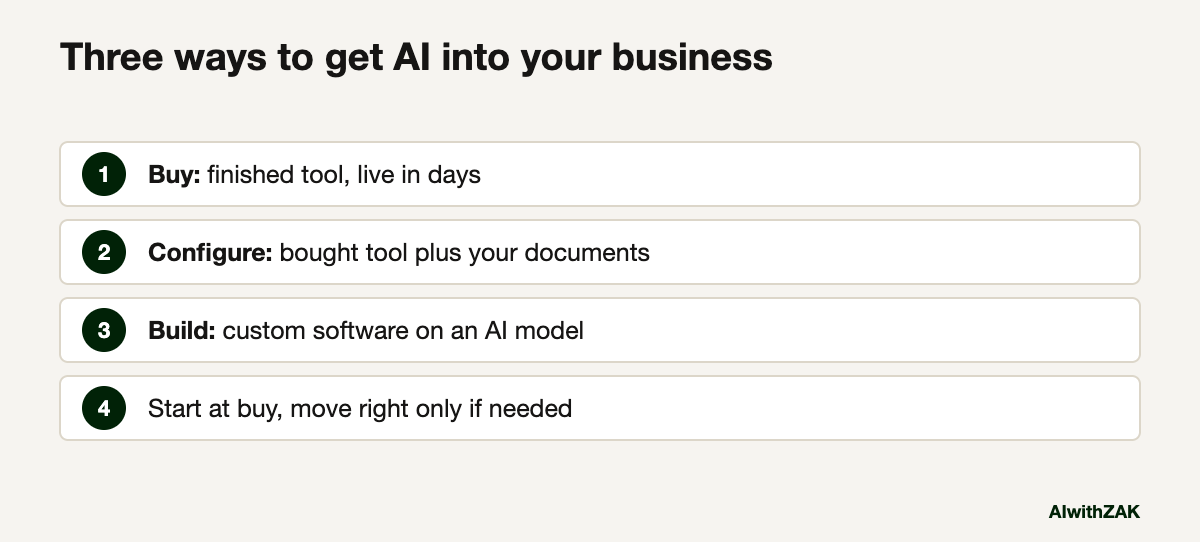
The choice between custom AI and off-the-shelf really has three options: buy a finished tool, configure a bought tool with your own documents, instructions and connections, or build custom software on an AI model. The middle option covers most of what Alberta businesses mean by custom AI.
Configuring means using the building tools that come with the product: custom GPTs in ChatGPT, projects in Claude, Copilot Studio agents in Microsoft 365. Many of these let the tool search your own files before it answers, a technique called retrieval-augmented generation, meaning the AI looks up the relevant documents first and then writes from them. What RAG is, and does your business need it explains it in more depth.
| Buy off-the-shelf | Configure a bought tool | Build custom | |
|---|---|---|---|
| Best for | General writing, summarizing, email, meeting notes, research | Answering from your own policies, specs, past bids; repeatable internal tasks | High-volume processes tied to your core systems or your competitive edge |
| What works | Live in days; vendor handles security, updates and models | Uses your knowledge without writing code; can be rebuilt in weeks | Fits your exact workflow, data and systems; you control the roadmap |
| What frustrates | Generic; doesn’t know your company | Limited by what the platform allows; needs someone to maintain the content | You own every bug, model change and security review, forever |
| Cost | Per-seat subscription, predictable | Subscription plus internal time, sometimes usage charges | Build cost plus ongoing hosting, usage, monitoring and developer time |
When is off-the-shelf AI good enough?
Off-the-shelf AI is good enough when the task is common across industries, the data is mostly documents and email, a person reviews the result, and nothing writes back into your core systems. That describes most first AI projects in professional services, construction and energy services offices.
Drafting proposals, summarizing site reports, answering HR policy questions, cleaning up meeting notes, first-pass contract review: vendors are pouring money into all of these, and their tools improve every quarter without you lifting a finger. A custom build of the same thing starts ageing the day it ships.
It’s also the lower-risk place to learn what your team will actually use. Prioritizing AI use cases tends to reshuffle once people have had a real tool for a month.
When is it worth building custom AI?
Build custom when four things are true at once: the process affects how you win or deliver work, it depends on data or systems no vendor supports, it runs often enough to pay for maintenance, and a configured tool has failed a pilot on your documents. Missing one means wait.
Illustrative example, not a client case study. Picture a Grande Prairie oilfield services company that estimates hundreds of jobs a year from a mix of field tickets, a twenty-year-old job costing database and one senior estimator’s memory. No vendor’s product reads that database. The estimator retires in eighteen months. The volume is high and the estimate is how the company wins work. That is a credible case for custom, and it overlaps with the retiring expert problem.
Now picture the same company wanting a chatbot to answer staff questions about the safety manual. A configured off-the-shelf tool does that well. Building it custom would be paying for a problem vendors have already solved.
Between those two sits the option I’d reach for most often in the estimating case: keep the model and the interface bought, and pay a developer only for the piece that connects them to the old job costing database. That connector is small. It can be replaced in weeks. When a better model arrives next spring, you switch to it without rebuilding the rest, and the estimator’s knowledge stays in a database you own.
Build the narrowest thing you can, and buy the rest.
One caution from Gartner, whose June 2025 forecast on agent projects noted that many use cases positioned as agentic today don’t require agentic implementations. Often the same is true of custom builds. Before you commission an agent, check if plain automation will do, which AI agents vs automation helps you sort.
What does custom AI cost after it’s built?
After launch, custom AI costs hosting, model usage, monitoring, security review and developer time whenever the underlying model or the business process changes. Those costs never stop. Before you approve a build, get a written estimate of year-two running costs and a named maintainer.
The build quote is the part everyone negotiates. The maintenance is the part that decides if the project survives. Model providers retire models on their own schedule. Your ERP gets upgraded. The person who understood the prompts leaves.
Budget for the full picture using what an AI tool really costs after the licence, and decide before launch how you’ll know the thing is working. How to know if an AI agent is actually working has a weekly review you can adapt for any custom build.
If a build is genuine development work, check AI funding for Alberta businesses in 2026 before you price it.
How do you decide between custom AI and off-the-shelf?
Run the cheapest option first on real work and let the results decide. Configure an off-the-shelf tool, pilot it for a few weeks on your documents with scoring set in advance, then scope any custom build around the specific gaps the pilot exposed. That keeps a build small and justified.
Before the pilot, answer five questions in writing. They take an hour and save a lot of arguing later.
- Who does this work today, and how many hours a month does it take them?
- What does a good result look like, in a form someone other than the author could score?
- Which systems does it touch? If the answer includes your ERP, dispatch or job costing software, check the vendor’s integrations before anything else.
- What happens when the AI is wrong? A person catching the error before it leaves the building is a very different risk from a customer catching it.
- Who will own it in year two? Name a person. A department doesn’t count.
Some builders will argue the opposite: that off-the-shelf pilots waste months and a focused custom tool pays back faster. For a company with a clearly unique, high-volume process, they can be right.
So here is how I’d handle the disagreement. If the buy camp is right about your process, the pilot proves it and you’ve saved a build. If the build camp is right, the pilot fails in a specific, documented way, and that documentation becomes the build spec. Either way, you run the pilot first, and you ask every vendor and builder the questions to ask before you sign.
My position is simple: no custom AI build without a failed off-the-shelf pilot on file.
Questions people ask
For most mid-market businesses, buy first. Configure an off-the-shelf tool with your own documents and instructions, pilot it on real work, and consider a custom build only if the pilot fails on a process that is central to how you win or deliver work, runs at high volume, and depends on data or systems no vendor supports.
One major study suggests so. MIT NANDA’s August 2025 report, The GenAI Divide, found AI tools bought from specialized vendors succeeded about 67% of the time, while internal builds succeeded about one-third as often. It was based on interviews, a survey and analysis of public deployments, so treat it as a signal rather than a guarantee.
Configuring means using a bought product’s own tools, such as custom GPTs, Claude projects or Copilot Studio, to add your documents, instructions and connections without writing software. Building custom means writing your own application on top of an AI model, which gives more control but makes you responsible for maintenance, security and model changes.
Increasingly they buy. Menlo Ventures’ 2025 survey of about 495 US enterprise AI buyers found 76% of AI use cases were purchased rather than built internally, compared with 53% purchased in 2024. Mid-market Canadian firms typically have smaller technical teams, which pushes the balance further toward buying.
Hosting, model usage charges, monitoring, security reviews, and developer time to retest and adjust the system whenever the model provider retires a model or your own business systems change. Ask any builder for a written estimate of year-two running costs and a named person responsible for maintenance before approving the project.