
Short answer. Alberta restaurants and hotels get the most from AI in the back office first: reading supplier invoices, costing menus, forecasting staff schedules, drafting review replies and answering routine booking calls and messages. Guest-facing chatbots come later, if at all. Adoption is low. Statistics Canada found 6.7% of Alberta accommodation and food services businesses used AI in the year to the second quarter of 2026, against 12.7% nationally, so the operators who start now start ahead of most of their street.
Figures verified 23 September 2026.
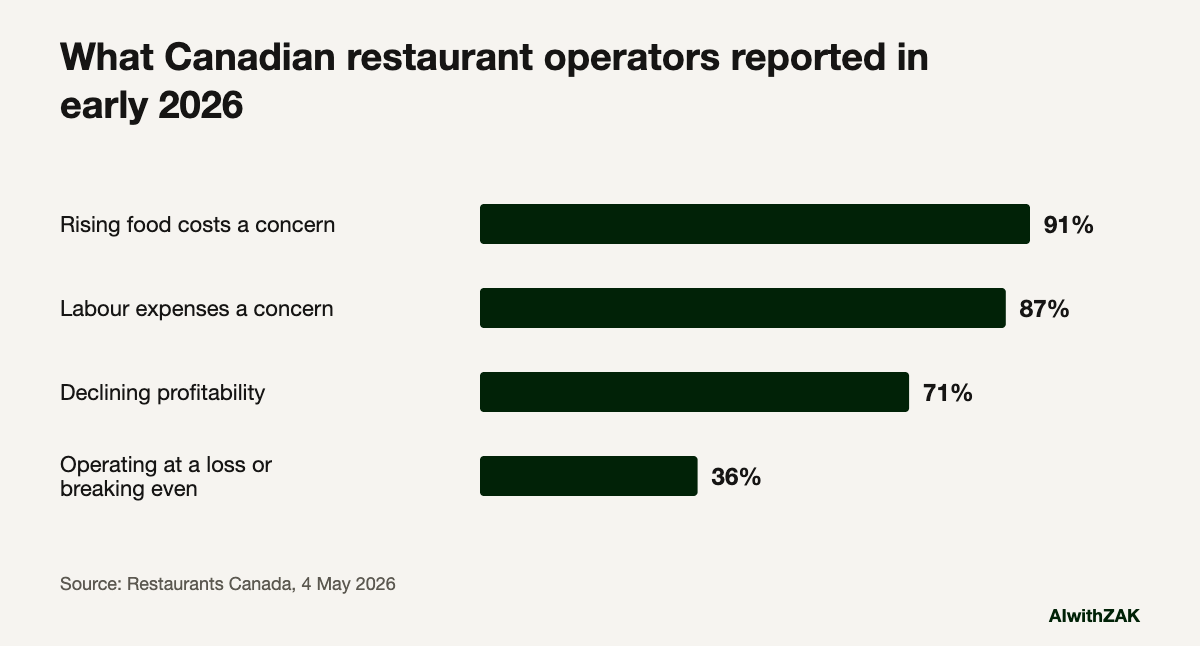
Restaurants Canada reported in May 2026 that 36% of Canadian operators are losing money or breaking even. That is triple the 2019 level, and it is the backdrop for any honest talk about AI for restaurants. 91% of operators named rising food costs as a problem, 87% named labour, and 71% reported declining profitability.
Those two lines are where AI belongs in this industry. Food cost and labour are the two largest numbers on the statement, and both are driven by paperwork nobody has time to read closely: supplier invoices that creep up a few cents a case, schedules built on gut feel from last year’s same week.
Alberta hospitality has barely started. Statistics Canada’s business survey for the second quarter of 2026 puts AI use in Alberta’s accommodation and food services at 6.7%, roughly half the national rate of 12.7%. The workers tell the same story. In a separate Statistics Canada survey of workers, accommodation and food services had the lowest share of workers using generative AI on the job of any industry, at 16.3%.
Meanwhile the demand side is strong. Travel Alberta reported a record $15.2 billion in visitor spending in 2025, with tourism employing 10% of Albertans. More guests, thin margins, tight kitchens. That is the setting for everything below.
Where does AI for restaurants actually pay off?
AI for restaurants pays off in the work between the kitchen and the accountant: reading invoices, tracking supplier prices, costing recipes, forecasting covers for scheduling, and drafting replies to reviews. These tasks eat owner and supervisor hours, run on text and numbers, and need no guest to trust a robot.
Start in the back office, not the dining room. Guests on 17th Avenue or Whyte Avenue came for people, food and a room. The owner, on the other hand, came for a margin, and the margin hides in documents.
| Use | Best for | What works | What frustrates |
|---|---|---|---|
| Supplier invoice capture and price tracking | Any operator buying from more than two suppliers | Photos or PDFs of invoices turned into line items, with price changes flagged week to week | Handwritten credits and substitutions still need a human pass |
| Recipe and menu costing | Kitchens changing menus seasonally | Plate costs recalculated when an ingredient price moves | Only as good as the recipe cards, which are often out of date |
| Cover and occupancy forecasting for schedules | Places with swings around events, Stampede, long weekends and hockey nights | Past sales, reservations and event calendars combined into a suggested schedule | Needs a year or more of clean point-of-sale data |
| Review and message replies | Hotels and busy restaurants with dozens of reviews a month | First drafts that a person edits in seconds | Unedited replies read as canned, which is worse than silence |
| Phone and booking assistant | Operators missing calls during service | Hours, directions, simple bookings, callback capture | Allergy, large-group and complaint calls must go to a person |
| Group and event proposals | Hotels, banquet rooms and caterers | A proposal drafted from an inquiry email in minutes | Pricing still needs a person who knows the calendar |
| Staff training material | Operators with high turnover or multilingual teams | Standard operating steps rewritten clearly and translated | Food safety content must be checked against the real rules |
The first row is the one I would start with in almost any kitchen. It needs no new habit from the line cooks, it touches no guest, and it turns into a number within four weeks.
Paste this into your AI. Use an approved business account, not a free personal one, and leave out anything with employee or guest names.
I run a [type of restaurant or hotel] in [town], Alberta. Attached are last month's supplier invoices. Extract every line item into a table with supplier, item, pack size, unit price and date. Then compare each item's price with the earliest invoice for the same item this month and list every increase above 3%, largest first, with the dollar impact if I keep buying the same volume. Finish with three questions I should ask my suppliers.
How can Alberta hotels use AI?
Alberta hotels get the fastest return from AI on guest messaging before arrival, drafting review responses, turning group and event inquiries into proposals, and reading reports from the property management system. Front desk judgment, complaints and anything involving refunds or safety should stay with staff.
A hotel in Canmore or Jasper answers the same handful of questions every day: parking, early check-in, pet fees, trail conditions, where to eat. An assistant that drafts those answers from the hotel’s own policies, for a person to approve or send, frees the desk for the guests standing in front of it.
Group business is the other quick win. Event inquiries arrive as long, messy emails. AI turns them into a structured proposal draft, and the sales lead fixes the rates. Planners often ask several venues at once, so the first good reply has an edge, and speed is exactly what a small property lacks during the summer rush.
Illustrative example, not a client case study. A 60-room property in the Bow Valley gets an occupancy report from its property management system and its review exports every Monday. An assistant reads both and writes one page: which room types sold out, which review themes rose this week, and which three reviews need a reply from the owner rather than the desk. The owner reads one page instead of four reports.
Should a restaurant or hotel put an AI chatbot in front of guests?
Only for narrow, factual jobs: hours, directions, menu details, booking changes. Anything the bot says can bind your business, so it must draw from your own current policies, hand off to a person on allergies, complaints and refunds, and be tested before guests ever see it.
An AI review reply that sounds like a bot is worse than no reply. The same goes for a chatbot that invents a cancellation policy. In Moffatt v. Air Canada, British Columbia’s Civil Resolution Tribunal held the airline to what its chatbot told a customer, and what the Air Canada ruling means for your business applies just as well to a hotel’s booking bot.
Allergies deserve their own line. No AI system should be the last word on which dishes are safe for a guest. That answer comes from the kitchen, every time.
If you do add something guest-facing, read what makes customer service automation work first, and compare it with the simpler option in chatbot versus AI agent. Most hospitality operators need the simpler one.
Can AI fix hospitality staffing problems in Alberta?
No. AI can take admin work off supervisors and owners and make schedules closer to real demand, which reduces overtime and short-staffed shifts. It can’t cook, clean rooms or serve tables, and hospitality has some of the lowest AI exposure of any Canadian industry.
Statistics Canada’s 2024 research on AI occupational exposure found accommodation and food services among the industries with lower exposure, alongside construction and manufacturing. In practice that means most hospitality jobs are physical, and AI helps the people who run them more than it replaces the people who do them.
Where it does help is the hours owners and supervisors lose to scheduling, ordering, reports and email. Those hours come out of the floor. Give them back and the floor is better staffed without a single new hire. For the busy-season version of this, covering summer staffing gaps with automation covers what to set up before May.
How much should a restaurant spend on AI to start?
Start with one business AI subscription, one back-office task and a four-week test with a number attached, such as hours spent on invoices or food cost as a share of sales. Spend more only once that number moves. Some useful features may already sit inside software you pay for.
Check your existing systems before buying anything new. Point-of-sale, scheduling, accounting and hotel property management vendors keep adding AI features. Toast, for one, turned its Toast IQ features into a conversational AI assistant in October 2025. Some of what you need may already be in your plan. The licence is also the small part of the bill: set-up, clean data and staff time cost more, which is why the total cost of an AI tool after the licence matters more than the monthly price.
Measure it like any other cost line. Measuring AI return in a small business lays out the simple version, and it works as well for a café in Lethbridge as for a hotel group in Banff.
Pick the invoice job. Run it for four weeks. If food cost doesn’t move, you’ve lost very little; if it does, you’ve found your first AI project and your budget for the second.
Questions people ask
The practical uses are back-office: reading supplier invoices and flagging price increases, costing recipes, forecasting covers for staff schedules, drafting replies to reviews and messages, and answering routine booking calls. Guest-facing chatbots are less common and carry more risk, because what they tell a guest can bind the business.
Statistics Canada’s Canadian Survey on Business Conditions for the second quarter of 2026 found 6.7% of Alberta businesses in accommodation and food services used AI to produce goods or deliver services in the previous 12 months, against 12.7% of the same industry nationally.
Yes, for routine calls such as hours, directions, simple bookings and taking callback details. It should hand off to a person for allergies, large groups, complaints and anything involving refunds. Test it with real call scripts before going live, and check what it says against your current policies.
Unlikely for most roles. Statistics Canada research places accommodation and food services among the industries with lower exposure to AI, because the work is mostly physical. AI mainly takes admin work off owners and supervisors, such as scheduling, ordering and reporting, which gives them more time on the floor.
Yes, if a person edits every reply before it is posted and no guest personal information beyond what is already public is entered. Unedited AI replies tend to sound generic, which can do more harm than no reply. Use a business account with training on your data switched off.
Supplier invoice capture and price tracking. It needs no change from kitchen staff, touches no guest, and shows up in food cost within a four-week test. Pick one number to watch, such as food cost as a share of sales. Run it for four weeks against a clear number before adding anything else.