
Short answer. AI in Alberta agriculture pays off fastest in the farm office, not the field: contract and delivery tracking, program paperwork, field records captured by voice, equipment manuals you can question, and training material for seasonal staff. Precision equipment already runs on data most operations underuse. Only 4.5% of Canadian agriculture, forestry, fishing and hunting businesses reported using AI in the second quarter of 2026, so the early movers still have room. Start with one paperwork job and measure the hours.
Facts and program details verified 23 September 2026.
The first job for AI in Alberta agriculture has nothing to do with drones.
It has to do with the kitchen table at ten at night, where the grain contracts, the spray records, the program forms and the parts invoices end up. That work doesn’t grow a bushel or put a pound on a calf. It still has to get done, usually by the same person who was in the cab at six.
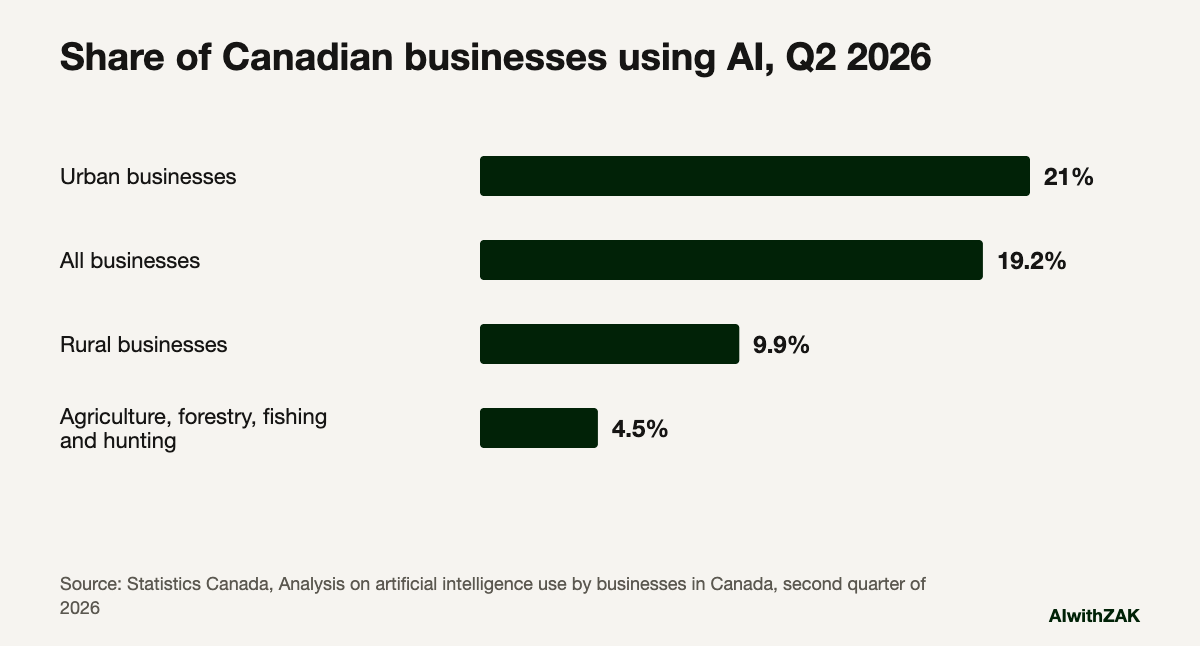
Statistics Canada’s survey for the second quarter of 2026 found 4.5% of businesses in agriculture, forestry, fishing and hunting used AI to produce goods or deliver services. That was the lowest of any industry it reported, against 19.2% across all Canadian businesses. Rural businesses sat at 9.9%, urban ones at 21.0%. I’ve put Alberta’s own adoption numbers next to the province’s data centre build in a separate piece, and the pattern holds here: the province that builds the computing is not yet the province that uses it.
Alberta had 41,505 farms at the 2021 Census of Agriculture, working about 19.9 million hectares. The operators skew older: 35,500 were aged 55 or over, and just over 5,100 were under 35. Canadian farm cash receipts passed $101.4 billion in 2025, and Alberta posted the largest provincial gain, up $1.4 billion. More revenue means more contracts, more records and more forms, handled by an older group of people. When a farm’s knowledge lives in one head, the paperwork and the know-how retire together.
Where does AI in Alberta agriculture actually pay off?
AI in Alberta agriculture pays off first in the office work around the crop and the herd: contracts, delivery dates, program applications, spray records, manuals and staff training. These jobs are repetitive, text-heavy and done at night. Field automation usually arrives inside equipment you already bought.
Here is how I’d rank the options for a family grain or cattle operation, or for the ag businesses around them: input retailers, seed cleaning plants, custom operators and feedlots.
| Use case | What it replaces | What it needs | First step |
|---|---|---|---|
| Grain contract and delivery tracking | A whiteboard, a spreadsheet and memory | Every contract in one folder, scanned or typed | Have a chat assistant turn this year’s contracts into a delivery calendar you check against the originals |
| Program and grant paperwork | Evenings spent retyping the same farm details into forms | Clean records of acres, equipment and costs | Draft one application from your own records, then read every line before it goes in |
| Field records by voice | The notebook on the dash that gets typed up in March, or never | A phone and a fixed template for product, rate, field and weather | Run one season of spray records through voice notes into a standard log |
| Equipment manual questions | Scrolling a long PDF manual in the shop | Digital manuals for the machines you run | Load one manual into an AI project and ask it the last three questions you had |
| Seasonal staff training | The owner explaining the same yard rules every spring | A walkthrough recorded once, on a phone | Record the grain handling walkthrough and have AI write it up as a checklist |
| Customer questions at ag retail | Staff answering the same product and hours questions all spring | Product sheets and policies in writing | Draft replies with AI and have a person send them for one season before automating anything |
| Livestock and bin monitoring | Some night checks and walk-throughs | Cameras or sensors, and a signal in the yard | See the technology running on a working farm before you buy it |
The equipment manual row sounds small. It isn’t. A tool that answers from your own documents, which is what retrieval-augmented generation, or RAG, means in plain terms, turns a shop full of manuals into something a new hire can ask. Better still, it can show you the page it answered from, which a general chatbot guessing from the internet can’t.
What about precision agriculture and autonomous equipment?
Precision agriculture already runs on data and automation inside guidance, section control, yield mapping and variable-rate systems. Most Alberta operations own more of this capability than they use. Fully autonomous equipment is still a research and early-demonstration field, so treat it as something to watch, not budget for this year.
The best place in Alberta to see this without a sales rep in the room is the Olds College Smart Farm. It runs more than 3,300 acres across six locations in Alberta and Saskatchewan, with a 1,000-head capacity feedlot and a commercial cow-calf herd. Its research focus lists autonomous equipment, sensors and data use. The college reports 84 projects in 2024/25 and 415 organizations engaged since 2018, run through the Olds College Centre for Innovation.
My position: before you buy a new sensor, pull the data your combine, sprayer and seeder already record, and find out what you’re doing with it. My guess is that for a lot of operations the honest answer is very little. That’s the cheapest AI project on the farm.
Is there funding for farm technology in Alberta?
Yes, but check the intake first. Alberta’s On-Farm Efficiency Program, under the Sustainable Canadian Agricultural Partnership, has a Smart Farm Technology stream capped at $50,000, cost-shared 50% grant and 50% applicant. The program page listed it as closed to new applications in September 2026.
The overall cap per applicant is $150,000 across the 2024 to 2028 program term, and the minimum application is $500. The province’s page said it was not expected to reopen before September 2026, so it’s worth watching the On-Farm Efficiency Program page this fall. The eligible items sit in a separate funding list, and that list decides what counts, not the stream name.
Most of the office use cases in the table above cost a monthly software subscription and some of your time, which no grant covers. For the wider picture, including federal programs, see AI funding for Alberta businesses in 2026. For the full cost of a tool once the licence is paid, what an AI tool really costs after the licence walks through the line items people forget.
Where AI in Alberta agriculture doesn’t help yet
AI is weak where a farm’s biggest calls get made: marketing timing, agronomy for your own fields, and anything that depends on a signal the yard doesn’t have. A general chatbot can explain a concept. It can’t see your field, and it doesn’t know next month’s canola price.
Agronomy advice from a general chatbot. It will answer confidently about seeding rates or fungicide timing. It doesn’t know if you farm east of Lethbridge or in the Peace country around Grande Prairie, what your field grew last year, or what disease pressure looks like in your area. Use it to prepare questions for your agronomist, never as the agronomist.
Product rates. The product label sets the rate. If an AI tool gives you a number, check it against the label every time.
Connectivity. Camera alerts and cloud-based sensors are only as good as the signal in the barn or at the bin site. Test coverage before you buy hardware that depends on it.
Marketing decisions. AI can summarize the market commentary you already read. It can’t tell you when to sell.
What are the risks of using AI on a farm?
The main risks are data ownership, confident wrong answers and employee privacy. A vendor may use farm data in ways the contract allows and you didn’t read. A wrong answer about a rate or a deadline costs money. Staff information in AI tools falls under Alberta privacy law.
1. Who owns the data. Yield maps, input records and herd data have value. Before signing up for any platform, find out if the vendor can use your data to train its models or share it in aggregate, and what you get back if you leave. The questions in what to ask an AI vendor before you sign apply to ag-tech the same way they apply to office software.
2. Deadlines and program rules. An assistant that drafts a program application can misstate an intake date or an eligibility rule. The government page wins, every time.
3. People’s information. Hiring records, pay details and temporary foreign worker files contain personal information. Alberta’s Personal Information Protection Act applies to farm businesses as it does to any private employer. Keep those files out of free consumer AI accounts, and read if ChatGPT is safe for company data before anyone pastes a payroll sheet into it.
4. The knowledge that leaves with a retirement. This one is a risk of not using AI. The Canadian Agricultural Human Resource Council forecasts that 38% of Alberta agriculture’s domestic workforce, about 18,500 people, will retire between 2023 and 2030. Much of what they know was never written down. Capturing a retiring expert’s knowledge with AI is one of the few jobs where recording a conversation now saves years later.
What does a first AI project look like on an Alberta farm?
A first project picks one paperwork job, measures the hours it takes now, runs it with an AI assistant for one season and compares. Grain contract tracking or spray records are the usual candidates because the inputs already exist and a mistake gets caught before it costs anything.
Illustrative example, not a client case study. Picture a family grain operation of about 2,000 hectares east of Lethbridge. Two generations, one full-time employee, a seasonal hire each spring. The son handles marketing and records at night. He puts every contract into one folder, asks an assistant to build a delivery calendar with tonnages and dates, and checks it against the paper. He sets up a voice note template for the sprayer. After one season he knows how many evenings it saved and how often the calendar disagreed with the contracts. Those two numbers decide if there’s a second project.
That’s the whole method. Pick the use case with the clearest payoff, measure it, then decide.
Paste this into your AI. Copy the prompt below into ChatGPT, Claude or Copilot, fill in the brackets and it will rank your own paperwork jobs. Leave out names, SIN numbers and bank details.
I run a [grain / cattle / mixed] operation in [area of Alberta], about [size] hectares, with [number] full-time and [number] seasonal staff.
Here are the office and paperwork jobs I do every year, with rough hours for each:
[list them]
Rank these by which one an AI assistant could cut the most hours from with the least risk of a costly mistake.
For the top one, tell me exactly what records I need to gather, what the assistant should produce, and what I must check by hand before relying on it.
Do not suggest buying hardware.
Farms that treat AI as an office hire, not a field machine, will get their evenings back first. Start with the contracts folder.
Questions people ask
Mostly in two places. Inside precision equipment, data and automation already drive guidance, section control and yield mapping. In the farm office, AI assistants are starting to handle contract tracking, program paperwork, voice-captured field records, equipment manual questions and training material for seasonal staff. The office uses are cheaper to start and faster to measure.
Statistics Canada reported that 4.5% of businesses in agriculture, forestry, fishing and hunting used AI to produce goods or deliver services in the 12 months before its second quarter 2026 survey. That was the lowest industry rate reported, against 19.2% for all Canadian businesses. Rural businesses overall were at 9.9%.
The On-Farm Efficiency Program has a Smart Farm Technology stream with a $50,000 maximum, cost-shared 50% grant and 50% applicant, within a $150,000 overall cap per applicant for 2024 to 2028. The province listed the program as closed to new applications when checked in September 2026. Check the program page for the next intake.
Use it to understand a concept or prepare questions for your agronomist. Don’t use it for a recommendation. A general chatbot doesn’t know your soil zone, field history or local disease pressure, and it answers confidently even when it’s wrong. Product rates always come from the label.
The Olds College Smart Farm runs more than 3,300 acres across six locations in Alberta and Saskatchewan, with a feedlot and cow-calf herd, and focuses research on autonomous equipment, sensors and data use. Producers and companies can work with it through the Olds College Centre for Innovation.
Whatever the contract says, which is why you read it before signing. Look for four answers: can the vendor use your data to train models, does it share data in aggregate, where is it stored, and what do you get back if you cancel. If the answers aren’t in writing, ask for them in writing.