
Alberta AI data centres now carry $13 billion of construction from Meta alone, while Alberta businesses trail the country on using AI. Statistics Canada found 18.4% of Alberta businesses used AI in the second quarter of 2026, against 19.2% nationally. The lasting return comes from companies putting it to work.
Figures verified 23 September 2026.
Drive about 35 kilometres north of Edmonton, into Alberta’s Industrial Heartland, and there are 1,750 acres being turned into 2.9 million square feet of computing.
Meta’s campus in Sturgeon County is a $13 billion project, the largest AI data centre investment in Canadian history. It will draw 970 MW from the grid, backed by a 932 MW gas plant from Pembina, Morgan Stanley Infrastructure Partners and Kineticor that is due in the second half of 2030, and a 250 MW supply deal with Capital Power. Construction peaks above 3,000 jobs. When it is finished and running, it employs about 300 people.
Three hundred. For $13 billion.
No criticism of the project is intended. That is the nature of the asset. Data centres are capital, land and power, with very little labour. Alberta’s own material is upfront about the trade: the province expects roughly $250 million a year in royalties, taxes, levies and transmission fees, charges a levy of up to 2% on the value of computing equipment, and puts no public money in. Most of the AI consulting work across Alberta I get asked about starts from the opposite end of that deal.
The deal is fine. The question is what Alberta does with the rest of it.
Alberta AI data centres and the line at the grid
The demand is nowhere near satisfied. The Alberta Electric System Operator set a one-time interim ceiling of 1,200 MW for large load connections. That allocation is fully taken. Behind it sit requests totalling roughly 19,565 MW.
Alberta’s all-time record peak demand is about 12,800 MW. The queue is more than one and a half times the entire province’s peak load.
The mechanics of Phase 1 tell you who this game is for. Projects had to be 75 MW or larger, had to avoid triggering transmission upgrades, and had to post financial security of roughly $14 million per 100 MW. The capacity was split pro rata among qualified projects in July 2025. A permanent framework is still being built, with a Data Centre Regulation effective June 2026 and a second phase covering tariff design, interruptible rates (cheaper power in exchange for agreeing to be cut off first) and cost allocation. The rest of the Alberta AI news that carries business impact sits downstream of those rules.
This is a supply-side boom, and Alberta is winning it on the things Alberta has always been good at: power, land, permitting speed and a tolerance for large industrial capital.
The number that should bother you
Now the other side of the ledger.
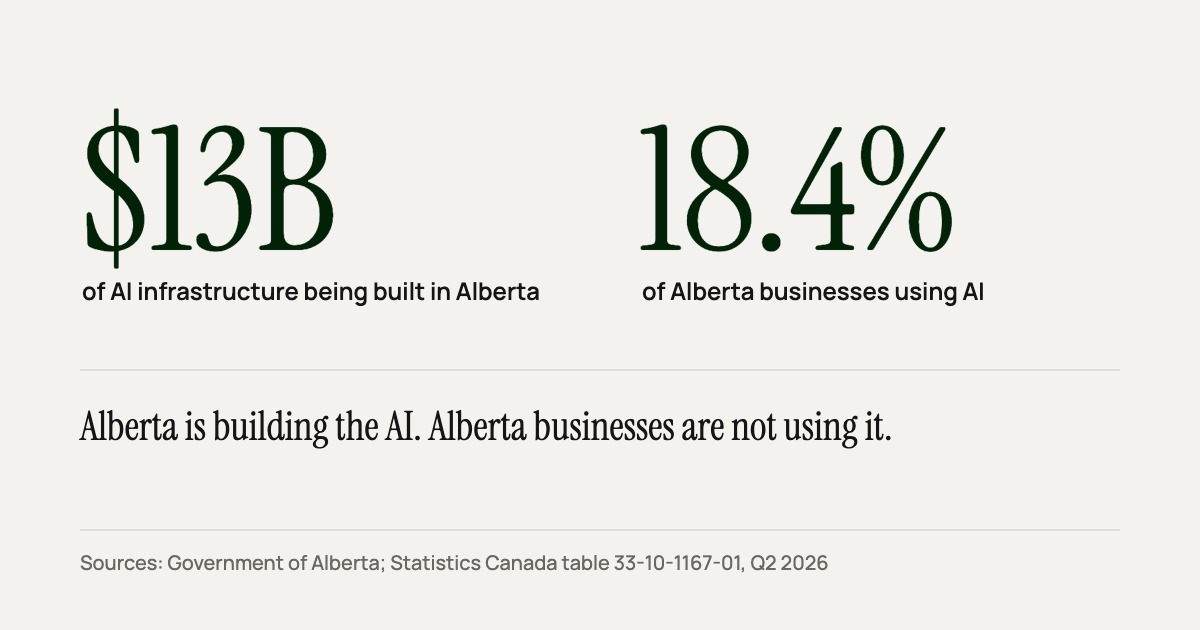
Statistics Canada’s Q2 2026 survey found 19.2% of Canadian businesses used AI to produce goods or deliver services in the previous 12 months. That is a real jump, up from 6.1% two years earlier. Alberta came in at 18.4%.
Below the national average. In the province building the machines.
The sector splits are where it gets uncomfortable, because they are Alberta’s own sectors. Transportation and warehousing reported 0.8% in Alberta against 9.8% nationally, and both of those numbers carry the survey’s highest reliability rating. Wholesale trade sat at 5.9%. Accommodation and food services at 6.7%. Construction came in at 8.1% and manufacturing at 9.3%, both at a weaker reliability rating, so treat those two as directional rather than precise.
A province that moves freight for a living is using AI in freight at roughly a twelfth the national rate.
Alberta is ahead in a few places. Information and cultural industries reported 69.8% against 42.3% nationally, and health care and social assistance 39.9% against 30.0%. Both sit in the survey’s weaker reliability bands, and neither is where most Alberta payroll sits.
Mining, quarrying and oil and gas extraction reported 13.4% in Alberta, the same as the national figure. For the sector that defines the province’s economy, matching the country is not a result to be pleased about. It is the same pattern behind AI for Alberta construction companies, AI for Alberta energy companies and the practical AI use cases in Alberta oil and gas: the opportunities are ordinary and the adoption is thin.
The most quoted line in the survey is the one about relevance. 40.0% of businesses said AI is not relevant to their business. Among those considering it, the barriers named were cybersecurity and privacy concerns at 13.4% and cost at 10.6%.
Federally, the national AI strategy sets a target of moving business adoption from 12% to 60% by 2034. The strategy uses a different measure than the survey above, which is worth knowing before anyone quotes both in the same sentence. Either way, the target says where the government thinks the return is. It points at businesses using AI.
The power bill argument, honestly
There is a fight about what all this does to electricity costs, and both sides publish numbers.
The Pembina Institute modelled the Meta project under Alberta’s bring-your-own-generation rules and projected that an average Alberta household could pay $270 to $460 more a year between 2027 and 2031, a 15% to 25% increase, with a 6% cut to the transmission part of the bill partly offsetting it. The Government of Alberta points at that same transmission effect and says the transmission part of household bills could fall by up to 6%, that data centres pay their own way, and that homes outrank large data centres during a supply emergency.
Two things worth saying plainly. The Pembina figure is a projection from an advocacy organization, and projections about Alberta’s power market have a mixed record. And the modelling covers households, not commercial or industrial rates, so no published analysis currently tells an Alberta business what to expect on its own bill.
If a meaningful share of your operating cost is electricity, that unanswered question belongs in your 2027 planning now, and the answer probably comes from your retailer rather than from a policy paper.
What this is actually about
Strip out the megawatts and the argument is simple.
Alberta is capturing the part of the AI economy that pays in tax revenue and construction employment. It is a real win and it is a one-time win. The part that compounds, the part that shows up as margin and capacity in Alberta companies decade after decade, comes from the demand side. From a Lethbridge fabricator cutting a week out of quoting. From a Calgary engineering firm getting proposals out in two days instead of nine. From an agricultural operation that stops losing a person’s worth of admin to paperwork. That is the case the Alberta AI Advantage blueprint makes at the provincial level.
That side of the ledger currently sits at 18.4%, and 40.0% of businesses have decided it does not apply to them.
The buildings will be there either way. Meta does not need Alberta business to adopt anything for the project to pencil out.
What to do about it
Three steps. The first two fit inside this week.
Pick the process that costs you the most and is the least differentiated. Quoting, scheduling, intake, reporting, claims. Whatever it is, the work is repetitive and nobody buys from you because you do it well.
Put an hour against measuring it. How many hours a week, across how many people, at what loaded cost. No AI needed for this step, and most companies cannot answer it, which is the actual reason AI pilots fail.
Change one thing and hold the measurement. One process, one owner, one number checked ninety days later.
That is the whole play. The province is spending $13 billion on the supply of computing. The return to your company comes from being one of the businesses that uses it, and the current numbers say most Alberta companies are not. If you want a second pair of eyes on which process to pick, that is most of what AI consulting in Calgary looks like in practice, and you can talk it through here.
Questions people ask
The Alberta Electric System Operator allocated a one-time interim ceiling of 1,200 MW for large load connections, which is fully taken, against requests of roughly 19,565 MW. Alberta’s record peak demand is about 12,800 MW. A permanent connection framework is in development alongside a Data Centre Regulation effective June 2026.
More than 3,000 jobs at peak construction and roughly 300 permanent positions, on a $13 billion, 1,750-acre campus in Sturgeon County north of Edmonton.
It is contested. The Pembina Institute projected an average Alberta household paying $270 to $460 more per year between 2027 and 2031, a 15% to 25% increase. The Government of Alberta says data centres pay their own way and that the transmission portion of household bills could drop by up to 6%. Neither analysis covers commercial or industrial rates.
18.4% of Alberta businesses reported using AI to produce goods or deliver services in Statistics Canada’s second quarter 2026 survey, against a national figure of 19.2%. Both figures carry the survey’s highest data quality rating. The source is Statistics Canada table 33-10-1167-01, released 27 May 2026.
In Alberta in the second quarter of 2026, transportation and warehousing reported 0.8% against 9.8% nationally, wholesale trade 5.9%, accommodation and food services 6.7%, construction 8.1% and manufacturing 9.3%. Information and cultural industries led at 69.8%. Reliability ratings vary by cell, so the construction and manufacturing figures are directional.
It delivers construction employment, roughly $250 million a year in provincial revenue and a levy of up to 2% on the value of computing equipment. It does not by itself raise the productivity of Alberta companies, which depends on their own adoption of AI.