

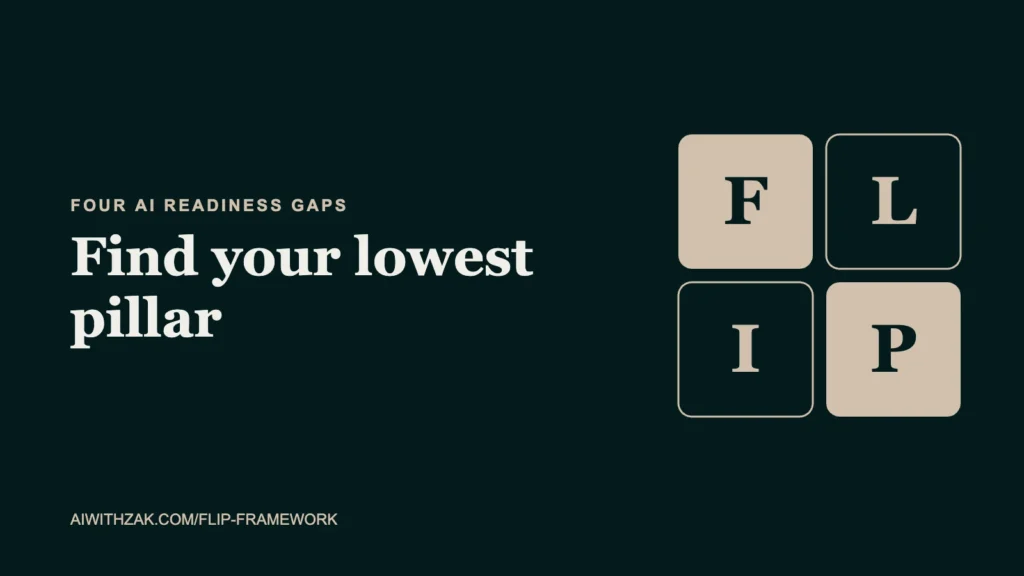
Take a hypothetical total of 64 out of 100. Building stage, solid base. I’d still want the four pillar scores before I believed it, because a 64 made of 22, 20, 14 and 8 is a business with a problem. The AI readiness gaps between pillars tell you where to work.
That spread is what the FLIP scorecard is built to catch. AI readiness gaps hide inside a decent total. Any spread of 8 points or more between pillars means one part of the business is running ahead of the rest.
What are the four AI readiness gaps?
Four patterns, each named by which pillar runs ahead. Fluency higher than Literacy is fast use with thin understanding. Literacy higher than Impact is smart talk with no results. Impact higher than Preparedness is wins without guardrails. Preparedness higher than Fluency is rules ahead of practice.
| Pattern | What it looks like | Fix first |
|---|---|---|
| F higher than L | People use AI daily, but nobody agreed what stays out of it | Literacy, with a one-page never-paste data list |
| L higher than I | Leaders talk about AI well, but nothing has been measured | Impact, with one workflow and one number |
| I higher than P | Real results, spreading faster than the rules | Preparedness, with a named owner and a written policy |
| P higher than F | The policy exists, but few people use AI | Fluency, with hands-on practice on real work |
Which gap is the most expensive?
Impact higher than Preparedness, in my view. The wins are real, so nobody wants to slow down, and the tools spread to people who never saw the rules. Once an agent can send an email or update a record, a missing owner turns into a customer problem fast.
Fast use with thin understanding comes a close second. The risk sits in what people paste in and what they trust coming out. Canada’s privacy commissioners publish principles for generative AI, and Alberta businesses also answer to PIPA. If your team scores high on Fluency and low on Literacy, ask who on the team has read either.
Why not simply raise the total?
Because the total rewards the pillar you’re already good at. Teams like doing more of what works, so the strong pillar keeps climbing and the gap gets wider. Work the lowest pillar first, even when the total looks good, and rescore it in 30 days.
Back to the 64. The 8 is Preparedness. So the next 30 days aren’t about a new tool. They’re about one named owner, a one-page AI use policy and a list of every AI tool in use, including the ones people pay for themselves.
If agents are already running, AI agent governance starts with that same owner question.
Score it yourself with the FLIP Framework, or run the reveal with your team using the one-hour AI readiness workshop. Writing those rules alongside a leadership team is part of my Fractional Chief AI Officer work.
AI readiness gaps, the questions leaders ask
What counts as a big gap between FLIP pillars?
A spread of 8 points or more between your highest and lowest pillar. Each pillar is scored out of 25, so 8 points is about a third of the scale. It means one part of the business is moving faster than the rest, and the slow part is where problems start.
Should we fix two pillars at once?
No. Pick the lowest and work it for 30 days with one owner and one date. Two pillars at once splits the owner’s time, and neither tends to get finished. Rescore after 30 days, then pick the next one.
What if all four pillars score about the same?
Then your total tells you the stage, and the stage tells you the work. Low and even means starting with shared language and one safe experiment. High and even means AI is part of how you work, so rescore every quarter to catch slips.
Find your lowest pillar before the next leadership meeting. Each Friday the AI Newsletter with ZAK covers one fix.