
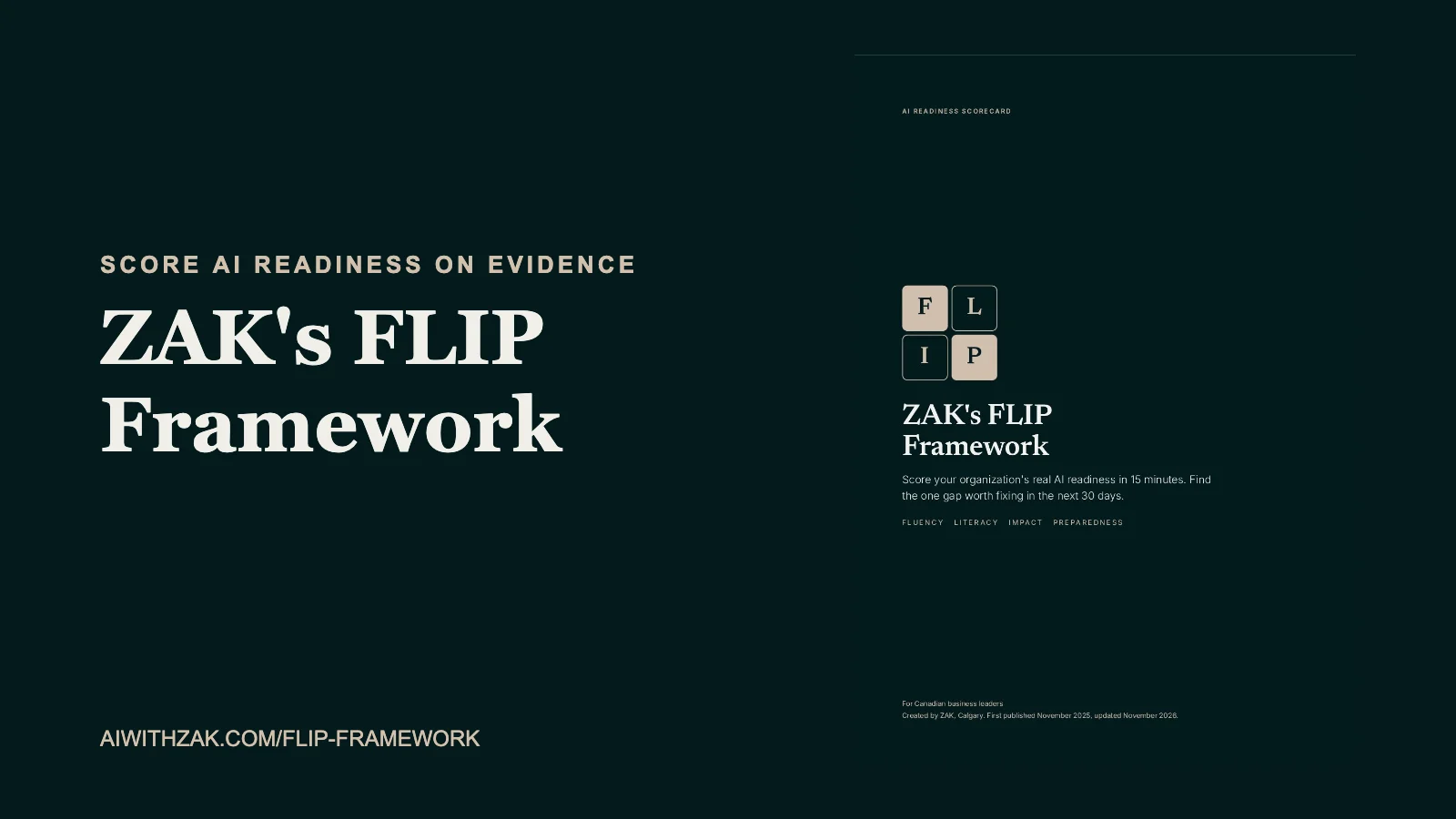
I built the FLIP Framework in November 2025 for one reason. Leadership teams needed a plain way to talk about AI readiness, and a list of the tools they’d bought wasn’t it.
FLIP scores four things: Fluency, Literacy, Impact and Preparedness. There are 20 statements, five per pillar, each rated 1 to 5. It takes about 15 minutes, and you can download the scorecard free. I updated it this November because AI tools now act. They send emails, update records and run tasks on a schedule, so the questions had to change too.
What does the FLIP Framework measure?
Four questions about your people and your business. Fluency asks if your people can use AI to do real work. Literacy asks if they understand it well enough to use it wisely. Impact asks if results changed. Preparedness asks if the business is set up to grow AI safely.
The first two pillars are about people, their skill and their judgment. The last two are about the business, its results and its guardrails. I split them that way because most trouble starts in the gap between the two halves.
| Pillar | The question | What a 5 looks like |
|---|---|---|
| Fluency | Can your people use AI to do real work? | Most of the team uses an approved tool every week, and good prompts get shared |
| Literacy | Do they understand AI well enough to use it wisely? | Everyone knows which data never goes into an AI tool, and why |
| Impact | Is AI changing results you can point to? | One workflow measured before and after, showing up in the numbers leadership already reviews |
| Preparedness | Is the business set up to grow AI safely? | Every agent has an owner, set permissions, an approval step and a log |
Why score on evidence instead of gut feel?
Because gut feel scores what you plan, not what’s true today. The scorecard has one hard rule: no evidence, no score higher than 2. If you can’t point to a person, a file or a number, the honest answer is 1 or 2, even if the tool is already paid for.
That rule stings a little. It should. A licence nobody opens scores the same as no licence, and a pilot that hasn’t started scores the same as no pilot. An edited vendor demo doesn’t count either.
Score alone first, then compare with your leadership team. The places you disagree often tell you more than the numbers do.
What does my FLIP total mean?
The total out of 100 tells you your stage. 80 to 100 is Operating, where AI is part of how you work. 60 to 79 is Building. 40 to 59 is Learning. 20 to 39 is Starting, where the job is shared language and one safe experiment.
I’d still treat the total as the least useful number on the page. Your lowest pillar tells you what to do next. A spread of 8 points or more between pillars means one part of the business is running ahead of the rest.
Where do AI agents change the score?
In every pillar. Fluency now asks if someone has handed a repeat task to an assistant or agent and reviews its work. Literacy asks if leaders understand that agents take actions. Preparedness asks if each agent has an owner, set permissions, an approval step and a log.
My view on this hasn’t moved. AI does the work, and people set the rules and decide where it stops. An agent with no owner and no log scores a 1 on Preparedness however clever it is. If you’re writing those rules now, start with an AI agent activity log.
Here’s how a gap looks, as a hypothetical example. A Red Deer oilfield services firm has a dispatch team using AI every day, so Fluency scores high. Nobody owns the tools, though, and no list says what data stays out. That’s fast use with thin understanding. The fix is Literacy before another tool.
What should I do after I score?
Pick your lowest pillar and work it for 30 days. One pillar, one owner, one date. Each pillar page on the scorecard lists three actions, such as a two-week practice sprint for Fluency or a one-page AI use policy for Preparedness. Then rescore that pillar.
Don’t try to fix all four. Rescore the full scorecard every quarter, because a 4 today can slip to a 3 when the tools move and your habits don’t.
To run it as a group, the free 60-minute FLIP workshop guide walks your leaders through scoring, the reveal and one next step. If you’d like me in the room, virtual or in person, that’s what my Executive AI Workshops are for.
FLIP Framework, the questions leaders ask
Is the FLIP scorecard free?
Yes. Download it from the FLIP Framework page on aiwithzak.com and share it with your team. It has 20 statements, five per pillar, and takes about 15 minutes to score alone before you compare answers with your leadership team.
Who should fill in the FLIP scorecard?
Each person on your leadership team, alone first. The owner or CEO, finance, operations and department heads work well. Compare scores after. Where you disagree by a lot, your leaders see the business differently, and that’s worth talking through before you spend more on AI.
How often should we rescore?
Rescore your lowest pillar after 30 days of work on it, then run the full scorecard every quarter. AI tools change fast, so a score that was true in spring can slip by fall if your habits stay the same.
Score alone this week, then compare. One move like this lands every Friday in the AI Newsletter with ZAK.