
Programs and figures verified 17 September 2026. Training grant section added 23 September 2026.
There is a category error running through every AI funding list in Canada, and it costs Alberta owners weeks.
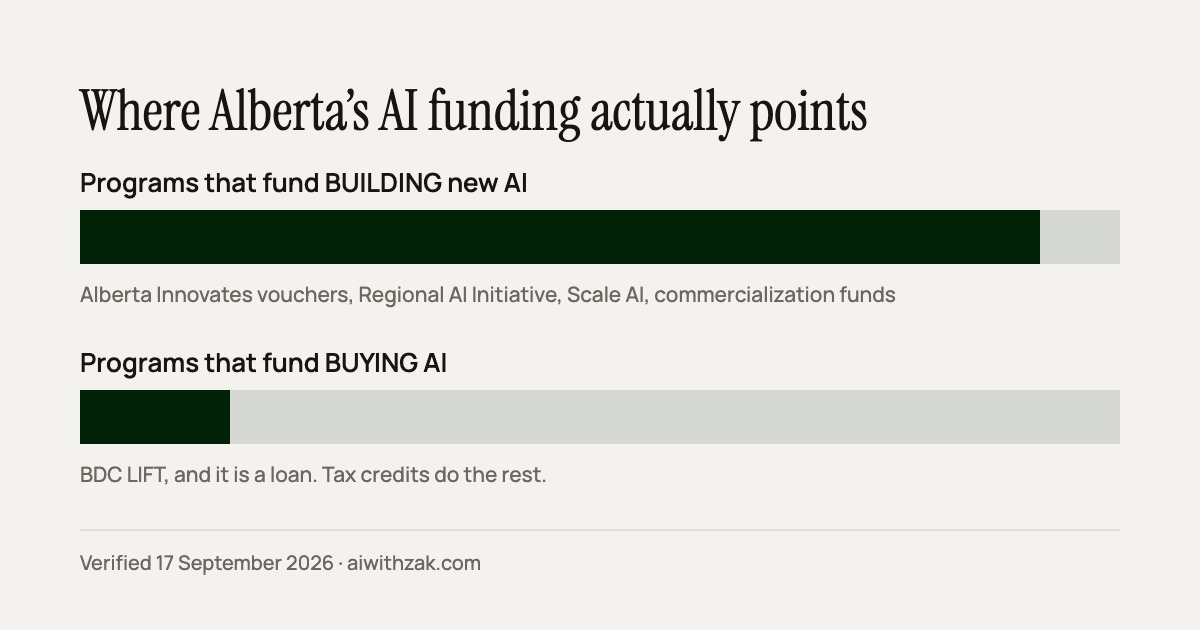
The lists mix two completely different kinds of money. One kind pays companies to invent and commercialize new technology. The other kind pays companies to buy and install technology someone else invented. Both get filed under “AI funding.” Only the second one applies to the plumbing contractor in Airdrie, the engineering firm on 4th Avenue, or the distributor in Nisku who wants to stop rekeying purchase orders.
Almost all of the money is the first kind.
That is worth knowing before you spend a Saturday reading program pages. Here is what exists, sorted by how likely it is to reach a normal Alberta operating business. It comes up in nearly every AI consulting conversation in Calgary and across the rest of the AI work I do in Alberta.
AI funding for Alberta businesses starts with the one program built for buying
The Business Development Bank of Canada launched LIFT on 24 April 2026 with $500 million behind it. Loans run from $25,000 to $5 million, at what BDC calls a preferential rate, with the option to postpone principal payments for up to two years.
The Digital Transformation and AI path is the relevant one. Eligibility is broad by the standards of Canadian programs:
- Canadian-based business with at least $1 million in annual revenue
- Open to all industries, with a short exclusion list that includes hotels and trucking companies running fewer than ten vehicles
- The technology has to be bought through Canadian suppliers or integrators
- A BDC Advisory Services plan is mandatory, not optional
Financing covers the technology itself plus installation, integration and implementation costs tied directly to that purchase. The amount you get depends on revenue, project scope and the financial strength of the company.
There is a second path, Productivity and Equipment, for automation and robotics. It sets the bar at $5 million in revenue and limits eligibility to manufacturing, transport and warehousing, wholesale, construction, agriculture, forestry and fishing, engineering services, and mining, oil and gas extraction.
Two things to be clear-eyed about. LIFT is debt. You pay it back. The mandatory advisory plan also means BDC wants a documented case for the spend before the money moves, which is the same case your own board would want. Sizing that spend realistically is its own exercise, and what AI consulting costs in Canada is the starting point most owners are missing.
That requirement is the single best argument for doing the planning work first. A company that already knows which three workflows it is changing, what those workflows cost today, and what the measurement looks like afterwards, walks into that conversation with the application mostly written.
The federal money that reaches Alberta sideways
On 4 June 2026 the federal government released its national AI strategy, called AI for All. It carries real numbers: $500 million for LIFT, $700 million to expand the Compute Access Fund, $500 million for the Canadian Tech Growth Fund, $500 million to expand the Regional Artificial Intelligence Initiative, $130 million for commercialization programs at the national AI institutes, and $50 million for the Canadian AI Safety Institute.
The strategy sets a target of moving Canadian business AI adoption from 12% to 60% by 2034.
For an Alberta operating business, most of those envelopes are upstream. The Compute Access Fund buys computing capacity. The Tech Growth Fund scales AI companies. The commercialization money goes through institutes like amii in Edmonton.
The Regional Artificial Intelligence Initiative (RAII) is the one that shows up locally. Prairies Economic Development Canada announced $6.8 million on 19 May 2026 across five Alberta organizations, supporting more than 70 jobs. The initiative itself was funded at $33.8 million over five years starting in 2024 to 2025, and the national strategy adds $500 million to expand it.
Read the recipient list before you decide it applies to you. RAII money goes to organizations improving productivity and commercializing AI solutions. If your company is buying a tool rather than productizing one, you are more likely to benefit as a participant in someone else’s funded project than as the applicant.
Provincial programs, and what they are really for
Alberta’s programs are innovation programs. That is a design choice. It shows in the eligibility language, which keeps using the same three words: novel, technology, commercialization.
Alberta Innovates Micro Voucher Program. Up to $10,000 in non-dilutive funding (money you do not repay and that costs no equity), with a minimum 25% cash contribution from you. Eligibility runs to Alberta-based companies with fewer than 500 full-time employees and under $50 million in revenue, a technology with intellectual property potential, and a project finished inside six months. Intake closed on 29 May 2026, and Alberta Innovates asks interested applicants to contact its team directly about next steps.
Alberta Innovates Voucher and Product Demonstration Programs. Larger versions of the same idea, aimed at moving a product toward commercialization.
Innovation Employment Grant. Up to 20% of qualifying research and development spending for small and medium-sized Alberta businesses. This one is worth a second look even if the first three are not, because software development done in-house can qualify as R&D in ways owners routinely miss.
amii. Edmonton-based, one of Canada’s three national AI institutes. Not a grant, but training and talent supports that cost less than the alternative.
The honest read: if you are buying Microsoft Copilot licences and building two agents on top of your own data, none of the voucher programs are pointed at you. If you are building something genuinely new inside your business and can defend the word novel, they are worth the application.
Scale AI
Scale AI reimburses up to 40% of eligible expenses on approved AI adoption and commercialization projects in supply chains, paid quarterly. A project needs more than one participant, and at least one of them has to be a small or medium business. One catch for timing: as of 23 September 2026, Scale AI’s funding page says the program is on pause until further notice.
The multi-participant rule is the real filter. A single Alberta company applying alone does not fit. Three companies in the same supply chain, with a technology partner, do. That shape takes longer to assemble and pays better when it lands, which makes the pause a good time to line up partners.
Training: the grant most Alberta owners miss
One program pays for people rather than technology, and for most Alberta operating businesses it is the closest thing to AI adoption money they will actually receive. The Canada-Alberta Productivity Grant reimburses employers for 50% of eligible third-party training costs for existing staff, up to $5,000 per employee per fiscal year and $100,000 per employer.
Digital and technological skills are one of the three eligible training categories, so AI training can fit. The rules still bite. The provider has to be separate from your company and have training as its main business. The training has to happen in Alberta, with a qualified instructor, and finish within 52 weeks. Self-study does not count, and neither do owners, family members or temporary foreign workers.
The rule that catches people: the application has to be in before the training starts. Book the workshop first and apply second, and the money is gone. The full walk-through, with a worked example, is in does the Canada-Alberta Productivity Grant cover AI training.
If you are planning AI training for a team, check this grant before you sign anything. It will not pay for a software licence. It can halve the cost of teaching people to use the one you already bought. What those sessions look like is on the AI training workshops page.
Tax credits move more money than grants
This is the part that gets skipped because it is boring.
SR&ED, the federal research and development tax incentive, and Alberta’s Innovation Employment Grant both return money for work you were going to do anyway. They do not require an application window, a pitch, or a partner consortium. They require records.
For most Alberta businesses spending real money on AI in 2026, the combination of a LIFT loan and a properly documented SR&ED claim will deliver more usable capital than every voucher program on the province’s list. It is also the combination almost nobody talks about, because neither piece makes a good press release. If you are already building the AI section of next year’s budget, this belongs in it.
Talk to your accountant before the fiscal year closes, not after.
The order to work in
- Write down what you are changing. Three workflows, the current cost of each in hours or dollars, and the number you expect afterwards. This is the document every one of the programs above asks for in some form, and choosing which use cases come first is the hard part of it.
- Book the SR&ED conversation with your accountant. Do this before the spend, because the records requirement is retroactive and memory is not.
- Take the LIFT conversation to BDC if you have $1 million or more in revenue and a Canadian supplier or integrator lined up.
- Check the Innovation Employment Grant against whatever development work you are doing in-house.
- Apply for a voucher only if the word novel survives a hostile reading of your project.
- Line up partners for Scale AI if your supply chain can support a joint project, and plan it as a two-quarter effort for when the program reopens.
What every funder is actually testing
Strip the forms down and each program asks the same question. Does this company know what it is doing with the money.
The applications that fail tend to describe the technology. The applications that land describe the work: the process today, the cost of that process, the change, the measurement, the person accountable for it. That is a business case, and the useful thing about writing one is that it is worth doing even if the funding never arrives. Knowing how to measure the return is what separates the two.
If you want a structure for that, the AI roadmap walk-through covers the readiness snapshot, the use case scorecard and the 90-day plan, which is most of what the forms are asking for in a different order. If it would help to talk it through before you start filling anything in, that is what the first conversation is for.
Questions people ask
Yes, but most are innovation grants for developing new technology rather than adoption grants for buying it. Alberta Innovates runs voucher programs up to $10,000 with a 25% cash cost share, and the province offers the Innovation Employment Grant at up to 20% of qualifying research and development spending. Continuous intake for the Micro Voucher Program closed on 29 May 2026 during a program review.
The closest fit is the BDC LIFT program, which is financing rather than a grant. It lends $25,000 to $5 million at a preferential rate to Canadian businesses with at least $1 million in revenue, and covers the technology plus installation, integration and implementation costs.
A $500 million Business Development Bank of Canada program launched on 24 April 2026. It has two paths. Digital Transformation and AI requires $1 million in revenue and a mandatory BDC advisory plan. Productivity and Equipment requires $5 million in revenue and is limited to named sectors including manufacturing, construction, wholesale and oil and gas extraction.
SR&ED covers eligible research and development, and software development for AI systems can qualify depending on the technical uncertainty involved. The test is the nature of the work rather than the label on the technology. Confirm the specifics with an accountant before the spend.
Yes. The Canada-Alberta Productivity Grant reimburses 50% of eligible third-party training costs for existing staff, up to $5,000 per employee and $100,000 per employer each fiscal year, and digital skills training qualifies. Apply before the training starts. Nationally, Canada’s AI strategy also commits $30 million to CanCode, which funds not-for-profits to deliver free digital skills training.